


Web-to-Print Lets Utah State University Grow and Evolve

Greg Christiansen believes Web-to-print (W2P) will take his in-plant to the next level.
“It was actually while attending an IPMA conference two years ago,” recalls the director of Aggie Print and Mail at Utah State University, in Logan, Utah. “We walked by a booth, and we spoke with a vendor that was offering a software, and I turned to my assistant that was with me and I said, ‘Yeah, it’s a lot of work, but I think in order to get to the next level, I think we ought to look at that.’ So, we agreed, and we started the process to look for something.”
Since then, Aggie Print and Mail has installed Docket Manager and has been able to automate the in-plant’s ordering process better than it had been with its previous third-party system.
“One of our biggest bottlenecks in our operation has been customer service and the input of jobs,” Christiansen says. “Right now, a lot of our jobs come in just through an e-mail and then we have to interpret what the customer wants, figure out the paper, do all that kind of stuff, and enter the job. With our old system, we were still having to do that. Even though an order might come in on the website, we still had to translate it. So, with this, the order comes in, and it automatically goes right into the flow.
“Now the job will come in, and then we distribute basically a card — no longer a full work order — with all the information on it,” he continues. “And so, our workstations and our employees can receive the job electronically.”
It’s because of those bottlenecks that Christiansen says he and his team had specific criteria for picking the new system — such as working off one database.
“We wanted it so that if we were to update pricing in our MIS, the pricing on the Web-to-print would automatically be updated. The inventory would pull and work seamlessly together,” Christiansen says.
Simplifying the Ordering Process
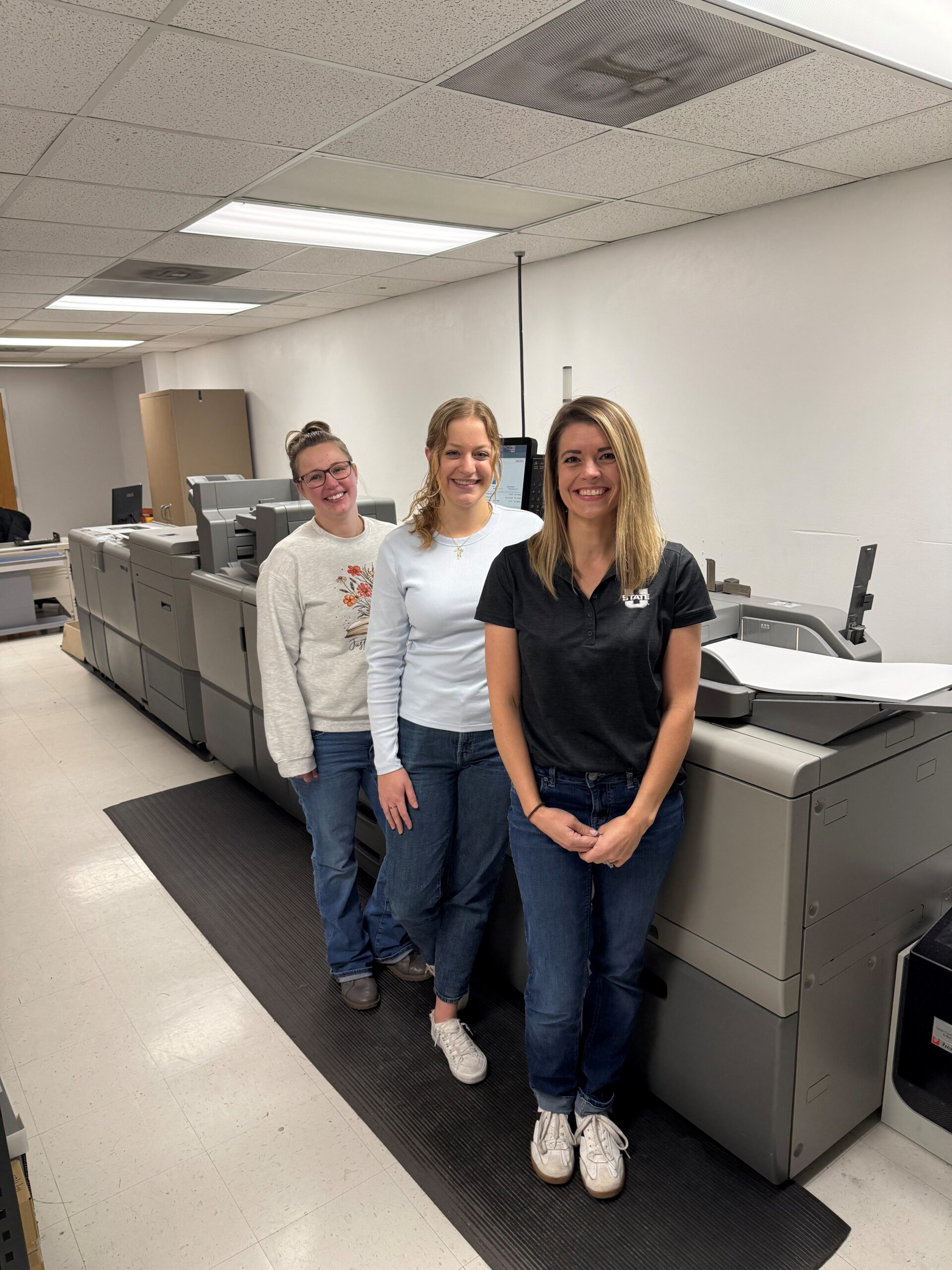
From left: Lacey Lee, Heather Lyman, and Annie Christensen stand with Aggie Print and Mail’s Ricoh Pro C7210SX.
Another reason for upgrading its W2P was to simplify the ordering process. Since the university has more than 100 logos for the different schools and departments, having a W2P system would make it easier for customers to find the logos they need, he adds.
“If you ... worked up in the School of Business, when you logged in with your identification number ... you would only see the logos that would apply to you, not the 100 and some odd logos,” Christiansen says.
As he and his team shopped around, they realized Docket Manager ticked a lot of boxes at just the right price point. Still, implementing it came with challenges.
“The old system had been implemented by someone no longer with us,” Christiansen says. “So, we didn’t have to recreate the wheel, but we had to go back and reset our pricing. Which was an advantage and a disadvantage. There was a lot of time that went into setting our pricing ... and the advantage was that we could really look at the way we were doing it, and do it the way we wanted it.”
The disadvantage was that he and his team had to start from scratch to determine pricing on some newer services.
“We were able to reach out to some other universities that have similar equipment and ask them how they’re doing some of the pricing,” he says. “For instance, flatbed UV printing and CNC is a new product. A vendor can give you some guidelines on how to set pricing, but how to really set it for us has been a little bit of a challenge. It’s just taken a lot of time; it’s taken more time than what we anticipated, but that’s because you’re trying to do it and still run a shop.”
Demonstrating Its Capabilities
Christiansen hopes steering customers to the website to submit jobs instead of doing it via email will allow the in-plant to demonstrate all of its capabilities.
“In-house, we have wide-format, roll-to-roll. We have flatbed UV and CNC cutting. We have screen printing, we have embroidery, we have dye-sublimation, we have engraving, we have mailing, we have embellishment — we have such a broad range of services,” Christiansen says. “And when people land on our website and are able to see everything in front of them ... the aim is that it’ll market ourselves better to let the people on campus know everything that we can do in-house.”
Overall, Christiansen’s words of advice for other in-plants that haven’t implemented a W2P system yet is to just do it — because without such a system, it will be harder to grow and evolve.
“In our case, we’ve got to have a Web-to-print,” Christiansen says. “We need it to continue to grow and to change. We could stay the same and not improve and not grow and stay where we are. But, if we want to take the next step, it’s a tool that we absolutely have to have.”
 Web-to-Print + AR for Today’s Print Providers
 Elevating Service, Sustainability, and Strategy at Yale
 Automation Software Demos Draw Crowds at Expo
 Fiery Delivers Touchless Color Control in Latest Release
 OnPrintShop Releases Version 12.1 of its Web-to-Print Solution
 OnPrintShop to Launch Version 12.0 With AI-Driven Capabilities

