Banking on Banners


Banners are big business for in-plants. According to the 2024 IPI study, “Trends and Services in the In-plant Industry,” 90% of in-plants produce banners. This year’s “In-plant Equipment Investment Trends” research further revealed that 17% of in-plants have banner hemming equipment, and another 8% plan to add it within the next two years.
What makes banners such an attractive application for in-plants? It comes down to both versatility and visibility for customers and events.

Banner produced by CHRISTUS Health's in-plant.
“Banners are widely used across our organization, especially by departments like talent acquisition, internal communications, and various hospital units,” notes Del Shankle, the director of operations, Marketing Print Services, at Christus Health in Irving, Texas. “They’re popular because they’re versatile, reusable, and effective for observances like Nurses Week, Healthcare Week, and seasonal campaigns. Pop-up banners, in particular, have become a go-to solution for recruitment events and internal messaging.”
At Western Carolina University, in Cullowhee, North Carolina, Al Goranson, director of Print and Mail, notes, “On our campus there are several designated locations for banners. Different student groups, departments, and athletics all use these locations. It allows them to get the word out on campus in a restrictive landscape. Banners are important to our customers because they have limited options for advertising events and activities.”
“Pretty much everyone needs a banner at some point to direct people where to go, or just to get a message out in a big way,” agrees Greg Christiansen, director of Aggie Print and Mail at Utah State University, Logan, Utah. “Most of our customers are departments, but students also do a lot of wide-format.”

At Western Carolina University Print and Mail, Mike McKendrick shows off banners being produced by the in-plant’s Canon Arizona wide-format printer.
All three directors note that banners offer a way for in-plants to meet an important demand, which helps justify the in-plant’s usefulness to the parent organization.
“Banners offer a great opportunity for in-plants to demonstrate value beyond traditional print,” says Shankle. “They allow us to support internal branding and communication efforts while offering cost-effective solutions. By producing banners in-house, we avoid outsourcing costs and gain control over quality and turnaround time.”
A More Visible Presence
Banners give in-plants a way to have a more visible presence, and to do so relatively inexpensively. After all, most in-plants already have wide-format equipment, and those that don’t can add it without breaking the bank.

Large banner produced by Utah State University's in-plant
“The equipment is relatively inexpensive, and with a comfortable mark-up it can produce a lot of revenue,” says Christiansen, of Utah State University.
And if an investment does need to be made, the equipment can print much more than banners.
“It can be a lucrative revenue stream, and it keeps work in-house,” Goranson notes. “Banners can also be done on machines that can do other work, like corrugated plastic signs.”
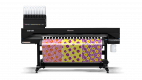
For example, Christus Health’s in-plant is printing on rigid, flexible, and heat-sensitive materials, using a Mimaki JFX-300 (UV-LED inks) and Canon Colorado M-series (UVgel inks). “These allow us to print high-quality banners on diverse materials with excellent durability and color fidelity,” says Shankle.
Western Carolina University’s Goranson notes that his shop is mostly producing UV-resistant banners, many of which are installed outdoors and are used repeatedly for events for many years. His operation is using a Canon Arizona and Roland LG2 printer for its banner work.
Utah State University has the broadest mix of the three, with three HP solvent printers and a Ricoh flatbed printer, giving the shop a lot of media flexibility, notes Christiansen.
Hemming and Grommeting
All have invested in hemming and/or grommeting equipment to help speed up operations and streamline costs. Shankle sums it up best: “After attending PRINTING United two years ago, I identified inefficiencies in our manual hemming and grommeting process. We invested in a hemming machine and an electric grommeter to streamline production. This has significantly improved our workflow and reduced delays.”
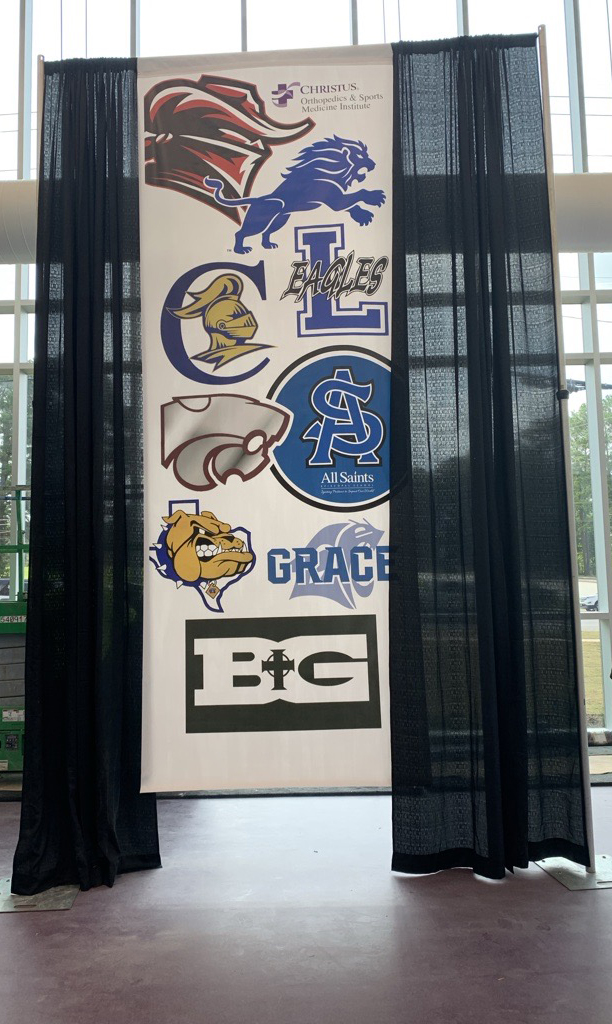
Banner produced by CHRISTUS Health's in-plant.
Though all three in-plants offer banner installation services upon request, many departments prefer to handle installation themselves. Goranson notes that when his team installs banners, he charges customers for this service.
For those in-plants that don’t yet print banners, these directors offer some advice.
“Standardize sizes and messaging templates to allow for reuse,” suggests Shankle. “Invest in durable hardware and design inserts that can be swapped seasonally. This approach reduces waste and improves efficiency.”
“Make sure the files you have to print from are high enough resolution to enlarge,” advises Christiansen, who also notes it “was an easy decision for us to add wide-format, and we may even add more in the near future.”
“Utilize equipment that can do many types of products — banners alone probably will not be enough to carry one piece of equipment,” points out Goranson. “Try to integrate into the campus sign and banner processes. Be the gatekeeper of graphic design standard on signage. Work closely with facilities or space managers that control the signage. Be cost competitive.”
There is a reason banners have jumped to the top of the list of applications in-plants provide. Wide-format equipment opens a range of opportunities, and banners are a great gateway into that world. Because no matter what business the parent organization is in, there is always going to be a need for banners and signage.
Toni McQuilken is the senior editor for the printing and packaging group.