Elevating Service, Sustainability, and Strategy at Yale


Yale Printing and Publishing Services’ management team (from left): Mario Maselli, Lisa Scott, John Poitras, Jason England, and Chris Peralta. | Credit: All photos, Yale University
When Yale University Printing and Publishing Services (YPPS) launched its Web-to-print system in August, it was an immediate hit with customers. Hundreds of jobs came in through the Print ePS MarketDirect StoreFront system from customers who had previously been emailing their files because the old system was simply not user friendly.
“It’s made us more efficient for sure,” says Lisa Scott, senior director of Creative and Logistics Services. “And it’s definitely improved our customer experience because the interface is much easier. It’s an online shopping portal.”
Making it simpler to work with the in-plant is just one of the positive changes YPPS has made over the past few years. New equipment, staff, and services are expanding the 40-employee in-plant’s value on campus.
With more than $8.7 million in annual revenue, which includes about $750,000 in external sales, YPPS is the country’s fourth largest university in-plant, according to IPI’s annual ranking. But while business is running smoothly today, the past few years have been a bit rougher for the New Haven, Connecticut, operation.
When Scott took over from previous director Jeff Gworek in December 2021, his retirement after 14 years in the job was one of nearly a dozen departures from YPPS, thanks to a generous retirement incentive Yale was offering. With long-time managers like Frank Savino and John Heine leaving as well, the retirement surge took away some of the top talent at YPPS. Scott had to quickly evaluate vacant positions, decide which to fill, and start hiring.
At the same time, she faced an operation still reeling from COVID, which had plunged the in-plant into the red after Gworek’s success building up the business in 2019.
“So all of the gains that had been made got lost when COVID hit because, obviously, the number of jobs dropped and the revenue dropped and everything stopped,” Scott says.
In the 3½ years since joining one of the nation’s most prestigious universities, Scott has worked hard to grow the business and enhance services, while slowly rebuilding the team. After 22 years at Bucknell University, where she oversaw print, mail, graphic design, Web, and digital communications, Scott was more than up to the task.
Staffing for Success
Her first hire was Mario Maselli, former manager of University of Hartford Print and Mail Services, whom she had gotten to know at Association of College and University Printers (ACUP+) conferences. In his new role as associate director of production operations, Maselli has expanded the in-plant’s wide-format operation, adding new substrates and applications. Loyal YPPS staffers like Jason England and John Poitras were promoted to new roles as well, where they have excelled.
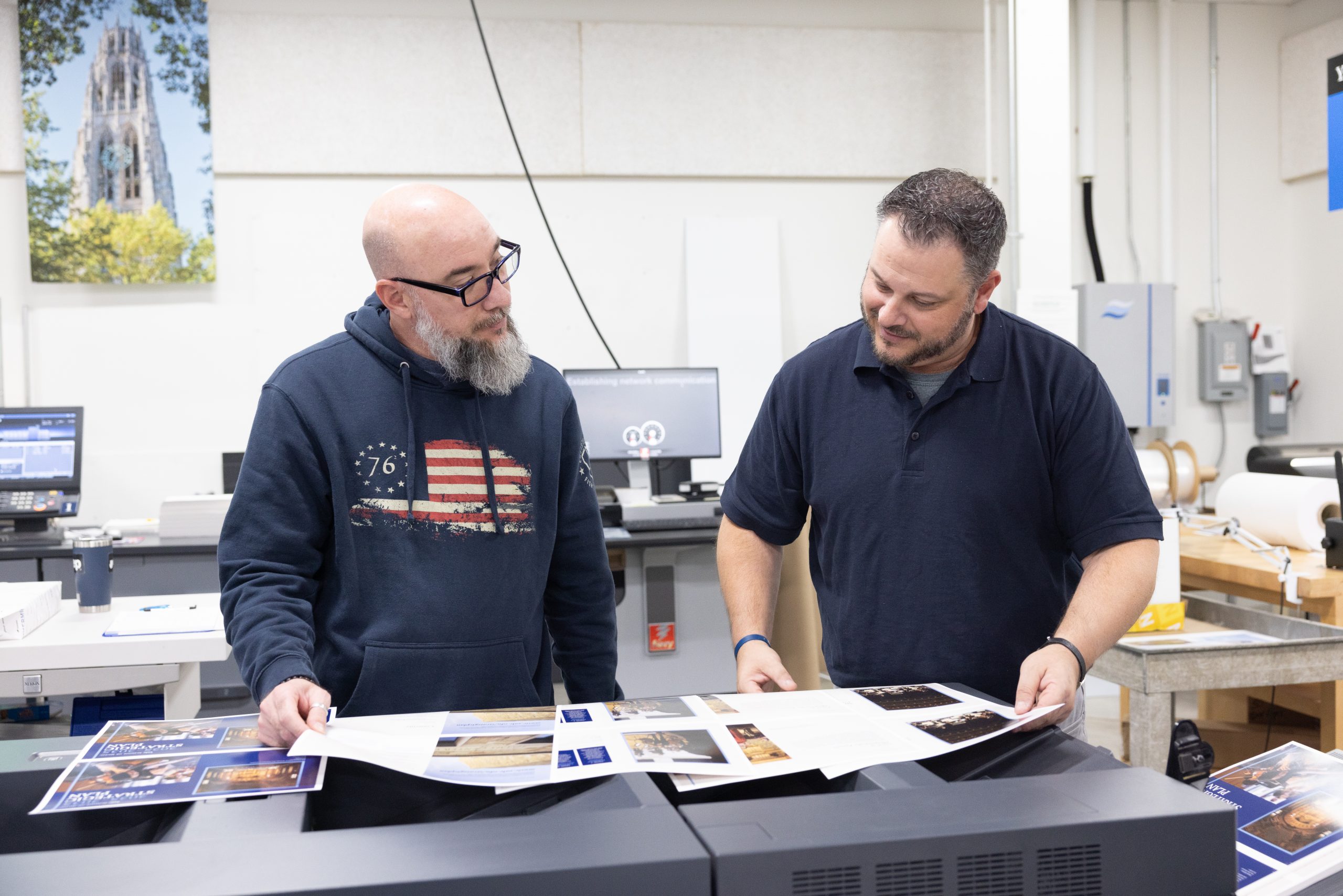
Cristian Garcia (left), digital print operator, and Mario Maselli, associate director of production operations, review run accuracy for the Yale School of Music’s Strategic Plan booklet.
To get the in-plant back in the black, Scott took a close look at opportunities being missed.
“I looked at all of the work that we were sending out to see if there was anything else we could keep in,” she says.
This brought in new business, including wide-format work. The in-plant has focused a lot of its efforts on keeping its two HP Latex 315 wide-format printers and Graphtec FC 9000-140 contour cutter busy, and it has paid off. Scott has her sights set on getting a flatbed printer if the shop can add space to its facility.

Sara Cardinal, digital print operator, finishes a wide-format fabric scientific poster for a Yale student using a hot-knife trimmer.
“We do a lot of print and mount now,” she says, work that would be easier to run on a flatbed. This would also allow the in-plant to bring outsourced signage back in-house, she says.
To further build up the bottom line, Scott put the shop’s costs under a microscope.
“As we were preparing to upgrade from Avanti to PrintSmith Vision [MIS], we looked at all of our pricing and made sure that it was accurate and that we were charging for everything that we were doing and made sure we weren’t giving things away,” she says. “So I think that also helped. Something as simple as a … delivery fee where we weren’t charging anything for delivery before. Little things added up.”
Scaling Back and Saving Money

Cristian Garcia queues the Yale School of Music’s Strategic Plan booklet cover to run on the Konica Minolta AccurioPress C6085.
Once a massive 70-employee powerhouse, Yale’s in-plant was strategically downsized by Gworek a decade ago. The university’s need for the shop’s space had triggered questions about whether Yale should move the in-plant or outsource it. Though Gworek and his team successfully demonstrated the value and savings the in-plant provided, he knew the in-plant could scale back its staff and still produce the same amount of work. Over time, he was able to reduce staff 37% through attrition and minimal layoffs, saving $2.2 million in salary and benefits. Offset made its exit in 2018, but the in-plant continued thriving with digital presses, earning both In-Print and ACUP+ awards.
In the past year, YPPS has invested in new equipment and software, such as the recent upgrade to PrintSmith Vision MIS and Print ePS MarketDirect StoreFront that has improved the customer experience and bolstered the shop’s efficiency.
“We’re capturing the account information, the contact information, the charging information, so it’s a lot less work once the job comes in,” Scott says. “They can see the price as they’re ordering it, which they couldn’t see before. They will now be able to see all of their history. So if they have a job where they’re ordering it regularly, they just go into their order history and reorder it.”
Bindery Upgrades
In May, the in-plant also boosted its bindery capabilities with a new Duplo 700i Pro bookletmaker, which allows it to produce square fold spines.

Yale School of Music’s Strategic Plan booklet running through the Duplo 700i Pro booklet maker for folding, stitching, and face trimming.
“We were really excited about the square fold option,” Scott says. “We do a lot of perfect bound books.” Some of those are now finished with square folds. Overall binding quality has gone way up, she says, compared to what the shop used to get from its 25-year-old bookletmaker.
In August, the in-plant added a Polar 92M Plus guillotine cutter to replace a 27-year-old cutter. Its ability to save and recall job setup information and its side air table are terrific productivity improvements, she says.

Patrick Porto, finishing and bindery operator, sets the cut parameters on the new Polar N 92 Plus to begin trimming the Yale School of Music’s Strategic Plan booklet cover.
The earlier addition of a Quadient DS-1200 intelligent inserter also dramatically improved productivity by handling the full addressing, inserting, and metering process, tasks that were previously done on three separate machines.
Scott renegotiated Yale’s copier fleet contract a few years ago, reducing click and maintenance charges and saving money. The in-plant’s own production printing fleet, however, has not changed. The shop runs two Konica Minolta AccurioPress C6085 digital color presses, two AccurioPress 6136 black-and-white presses, and an AccurioPress 6120 black-and-white unit.
Expanded Oversight
In July, Scott’s role at Yale was expanded. In addition to YPPS she now also oversees transportation, receiving, storage, and relocation services and an additional 48 employees. Included in her new responsibilities are student and faculty mail. To improve that service, she is implementing a package tracking system as well as package lockers.

YPPS has increased its fulfilment business over the past year. Here, Nodjua Johnson (left), manual finishing and fulfillment specialist, and Matthew Cusmano, mail services lead, begin assembling Yale School of Management’s New Student Acceptance kits.
YPPS is also broadening its services. Drawing from the shop’s experience fulfilling COVID-related items like masks, gowns, and hand sanitizer during the pandemic, YPPS has increased its fulfilment business over the past year.
“We have taken over fulfillment for new employee orientation, so we get a list of new employees and we assemble a welcome box for them,” Scott says. The in-plant does this twice a month, in addition to fulfilling welcome packs for many of Yale’s professional schools.
YPPS also generates revenue by selling promotional products. This is handled by its outsource group, which is also in charge of procuring large print jobs that don’t fit the shop’s equipment. The total revenue from that group is about $2 million.
“It just makes us valuable and more visible,” she says of these and other services YPPS offers, such as Web design and development, e-newsletter design, document scanning, and shredding. “We’ve done a lot … in the past few years to make ourselves more visible.”
To market its services, the in-plant highlights its successes in an enewsletter and on LinkedIn, hosts shop tours, and Scott gives presentations to departments detailing how YPPS can assist them in their missions.
Green Focus
Recognizing Yale’s goal to become a leader in sustainability, YPPS had made efforts to reduce its own environmental impact. In 2023, the in-plant replaced its delivery truck with an electric cargo van. Not only does it run quietly, it has eliminated exhaust fumes from campus and costs less to run than a gas-powered vehicle.

Yale Printing and Publishing Services’ management team (from left): Lisa Scott, John Poitras, Jason England, Mario Maselli, and Chris Peralta.
More recently, the in-plant made headlines for switching the substrate used to print research posters to Green Valutex, a fabric made entirely from recycled plastic bottles. By using this eco-friendly material in place of virgin substrates, YPPS saved 340,000 gallons of water, slashed energy use by nearly 20%, cut 8.5 tons of CO₂ emissions, and repurposed 18,000 plastic bottles in just one year.
Before switching, YPPS staff rigorously tested the fabric for color accuracy, print quality, and durability. Students and faculty love the material because the fabric can be folded for travel and easily refreshed with a quick steaming. Because of these eco-friendly initiatives, YPPS recently received its second consecutive Green Service Award from ACUP+, highlighting its leadership in sustainable print practices.
In the end, Scott says, the in-plant’s success comes from how well it serves its customers, and she feels advancements like YPPS’s new Web-to-print system, its fast turnaround times, and the range of capabilities it provides are keeping customers happy.
“The variety and the breadth of services that we offer is pretty vast, and we are constantly changing it,” she says. “We’re always looking for something new.”
Customers, she says, appreciate that.
“We've got a really good reputation with our campus partners,” she says.
Bob has served as editor of In-plant Impressions since October of 1994. Prior to that he served for three years as managing editor of Printing Impressions, a commercial printing publication. Mr. Neubauer is very active in the U.S. in-plant industry. He attends all the major in-plant conferences and has visited 200 in-plant operations around the world. He has given presentations to numerous in-plant groups in the U.S., Canada and Australia, including the Association of College and University Printers and the In-plant Printing and Mailing Association. He also coordinates the annual In-Print contest, co-sponsored by IPMA and In-plant Impressions.