


Navigating Disruption and Driving Innovation


The following article was originally published by Printing Impressions. To read more of their content, subscribe to their newsletter, Today on PIWorld.
“Every market disruption, whether economics such as a recession, or technological such as AI and smart robotics, or political like the recent change in tariff policies, creates opportunity that someone will capture to come out of the disruption stronger than they went in. So what I'd like you to do is ask, ‘How can I use everything I am learning at thINK Ahead 2025 to capture those opportunities and prepare for the virtuous cycle ahead?’”
Andy Paparozzi, chief economist at PRINTING United Alliance, posed that question to attendees at the annual Canon production inkjet user conference in Boca Raton, Florida (July 14-16). His panelist presentation was part of the session “Predicting the Next 5 Years in the Commercial Print Industry in a Time of Chaos,” hosted by Marco Boer, president of I.T. Strategies, and also featured fellow panelist Lori Messina, president of Farmingdale, New York’s Access Direct Systems, and immediate past president of the thINK board of directors.
Paparozzi shared that based on research conducted by the Alliance, the industry has faced weak growth in 2025 due to market uncertainty. According to the latest industry survey, sales are up just 0.7%, and less than 30% of companies report increased profitability. Additionally, more than half are delaying capital investments due to this disruption.
However, Paparozzi noted he is optimistic for the future. Consumer confidence is rebounding, driven by rising incomes, a recovering stock market, and moderating inflation. Productivity is also increasing, fueling a "virtuous cycle" where higher productivity leads to higher wages, more spending, increased demand, and sustainable growth.
A major driver of this next cycle will be the rise of artificial intelligence (AI) and smart robotics — including collaborative robots (cobots) and autonomous mobile robots (AMRs). These technologies will automate complex tasks and transform industries, including printing.
Paparozzi advised attendees not to delay in preparing for this transformation. Instead, he suggested they develop proactive strategies for integrating AI and robotics to increase efficiency, identify growth markets, and improve customer analysis.
One such company that has implemented AI heavily in managing production, inventory, and tracking is Access Direct. Messina noted though that while her company hasn’t yet invested in robotics, it is already having those discussions.
“It's in the planning stages,” she said. “I don't know how far that's going to go, but I do predict in our future, it's going to be massive in that direction. With everything else that we're talking about, I don't know how else we're going to manage our business if we don’t do that.”
Exploring Trends and New Technologies
The power and potential of AI bled into other sessions as well. In a session with Nicole Bond, associate director of marketing strategy at Mintel Comperemedia, she shared trends, insights, and innovations in the direct mail space. She pointed to three trends in particular: increases in the use of AI, more complex digital integrations, and campaigns designed for younger generations.
She noted that buy-in is rising for personalization in direct mail, with 84% of marketers agreeing that it significantly improves response rates. AI, she reasoned, is positioned as the answer to personalization in the mailbox. Layering several data points together can be more effective, she said. For example, most campaigns use three data points to form a “personalized” piece, however, by employing more advanced data targeting with five or more data points about the recipient, research shows a 16% higher conversion rate.
“What marketers find when they layer the right data points … their conversion rates are higher,” she said. “The more you know about your customer, you're able to earn higher value in those moments, specifically in line with what they're looking for or not looking for at that point in time. So when we look at the future of personalization, our goal and our hope is that it maps to the individual and not to the masses.”
Another key trend in the printing industry is the importance of workforce development, so it was no surprise that it was the focus of one of the opening sessions during the event. Lisbeth Lyons Black, director of Women in Print Alliance moderated a panel exploring how print service providers (PSPs) can build an internship program. She was joined by John Slaney, executive vice president of technology at Santa Ana, California-based FSSI, and Chris Kropac Jr., president and owner of Charlotte, North Carolina’s PCI Group. Both Slaney and Kropac shared their strategies, with FSSI employing a more laid back approach and PCI Group implementing a more structured internship program.
Slaney shared some key factors to consider, including:
- Establishing meaningful outcomes for both the company AND the intern
- Immersion in company culture
- Exposure to real-world work scenarios
- Evaluating direct and indirect ROI
Kropac outlined his company’s structured 10-week program, which includes compliance training, six sigma belt certification, department rotations, career preparation, and a final PowerPoint presentation in front of company managers, executives, and Kropac himself. He then shared some of his intern success stories and noted that even though the program is beneficial for the next generation, it also serves as a “shot in the arm” for current employees, giving them a boost of motivation and excitement for a few months.
Color Calibration is Key
Jordan Gorski, vice president of Global Standards and Certifications at PRINTING United Alliance, led one of the final sessions of the day with a deep dive into G7 and G7+. G7+, he explained, is built on the foundation of G7 and is a calibration specification focusing on gray balance and tonality. It is intended to serve all technologies to provide brands, PSPs, and print manufacturers with visual consistency.
He noted that G7+ provides some key enhancements over the G7 methodology. While it preserves G7’s basic features, it improves the underlying color science, serves a larger range of markets and print applications, and it is future compatible. It also provides a better gray balance, simplified tonality equation, improved ICC profiling, with optimized three-color overprints, and minimal impact from substrate corrected color aims (SCCA). For attendees looking for more information and specific case studies, Gorski shared a resource for further exploration and encouraged them to attend the upcoming G7/G7+ Exchange event taking place the day before PRINTING United Expo (Oct. 21, Orlando, Florida).
Technology Takes Center Stage
No thINK Ahead conference would be complete without a state of the industry from Canon and a look at some of the innovative technology available to attendees.
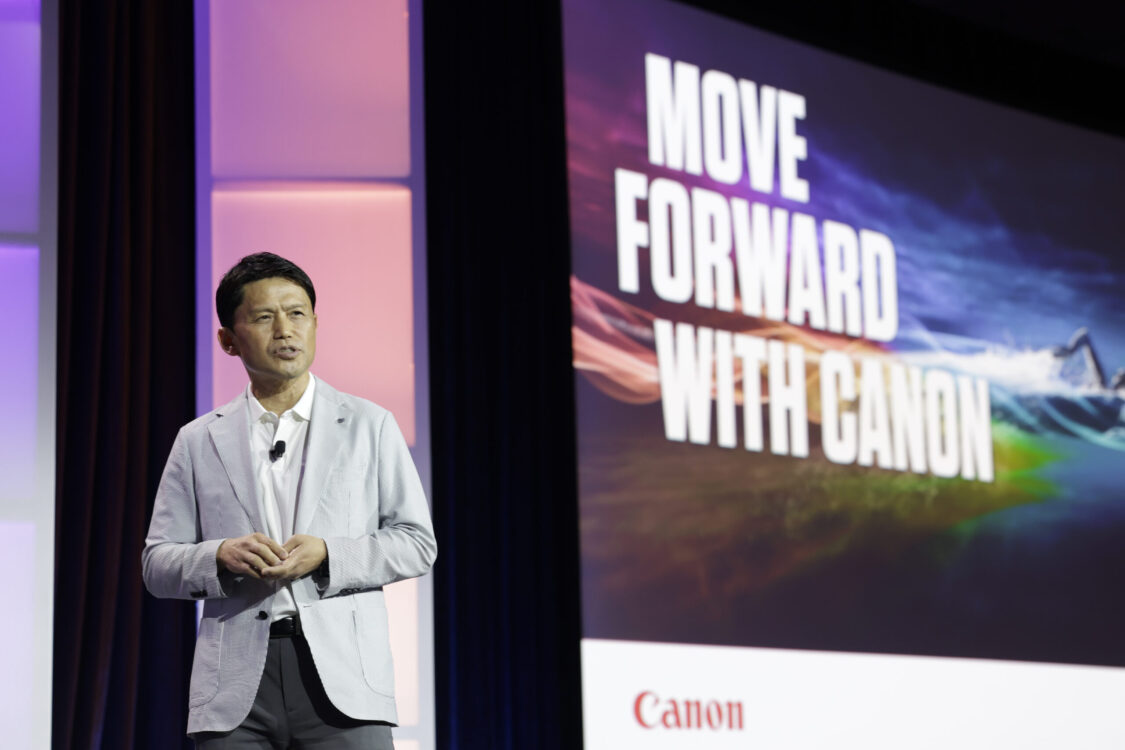
Isao “Sammy” Kobayashi, president and CEO of Canon USA, greeted attendees with a glimpse of how they can “move forward with Canon.”
Isao “Sammy” Kobayashi, president and CEO of Canon USA, greeted attendees with a glimpse of how they can “move forward with Canon.” He shared that Canon is in the process of a comprehensive reorganization, aimed at serving customers better.
“It's all about how we can serve our customers better,” he said. “So that's the idea of one Canon. And talking about one Canon, I'd like to continue this great relationship together with you. And by adding more customers, I'd like to build one big, beautiful team.”
Following Kobayashi’s presentation, Takao Hada, advisory director and deputy chief executive, Digital Printing Business Operations, Canon Inc., took the stage to highlight some of Canon’s most recent technology, including the varioPRINT iX1700. He pointed out that the high-speed production inkjet press accommodates a diverse range of substrates and meets growing demands for more sustainable production.
With 435 attendees and 43 sponsors at this year’s event, it was an opportunity to connect on the most pressing issues in the printing industry, stay apprised of the most innovative technologies, and network with peers. Next year’s event is planned for July 13-15.



Ashley Roberts is Content Director of Printing Impressions.


