Becoming California's 'Printer of Choice'

Visiting California’s Office of State Publishing (OSP) can be an overwhelming experience. Unlike the more modest facilities of a typical in-plant, OSP’s 128,000-sq.-ft. main plant rivals most commercial printers in size and scope.
The country’s second largest in-plant, behind only the U.S. Government Publishing Office in Washington, D.C., OSP is one of the few in-plants with a web offset press: an eight-color Harris M-1000B. The press consumes an average of 20,000 lbs. of paper each day to churn out millions of voter information guides, driver’s license handbooks, tax forms, and other essential documents.
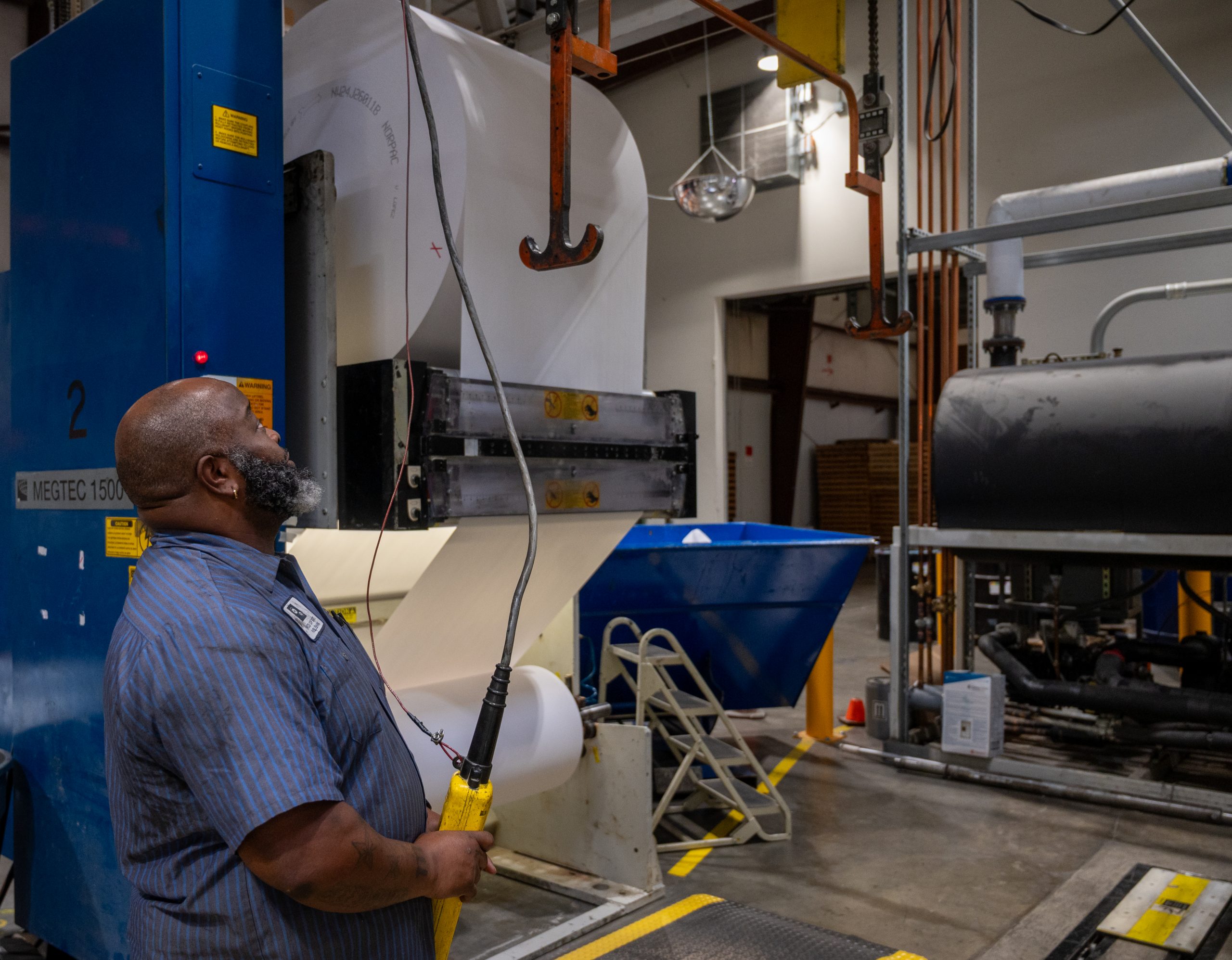
Inside the pressroom at the California Office of State Publishing, Dwayne Moore operates the hoist on a roll lift for the in-plant’s eight-color Harris M-1000B web offset press.
OSP’s six-color, 40" Heidelberg Speedmaster sheetfed press stays busy printing unemployment claim forms, DMV driving manuals, calendars, booklets, brochures, posters, and newsletters. Drent and Muller Martini web forms presses print driver’s license renewal forms, tax forms, newsletters, invoices, and certificates, and two Halmjet presses turn out roughly 33 million envelopes per year.
The 252-employee in-plant has a substantial digital printing operation as well. In its main plant, three Canon varioPRINT 6330 monochrome digital presses print high volumes of legislative materials, usually late at night, after the legislative sessions end. OSP may get 200-300 bills a night and must print 500 sets of each by the next morning. Some legislative books can be 800 pages long.
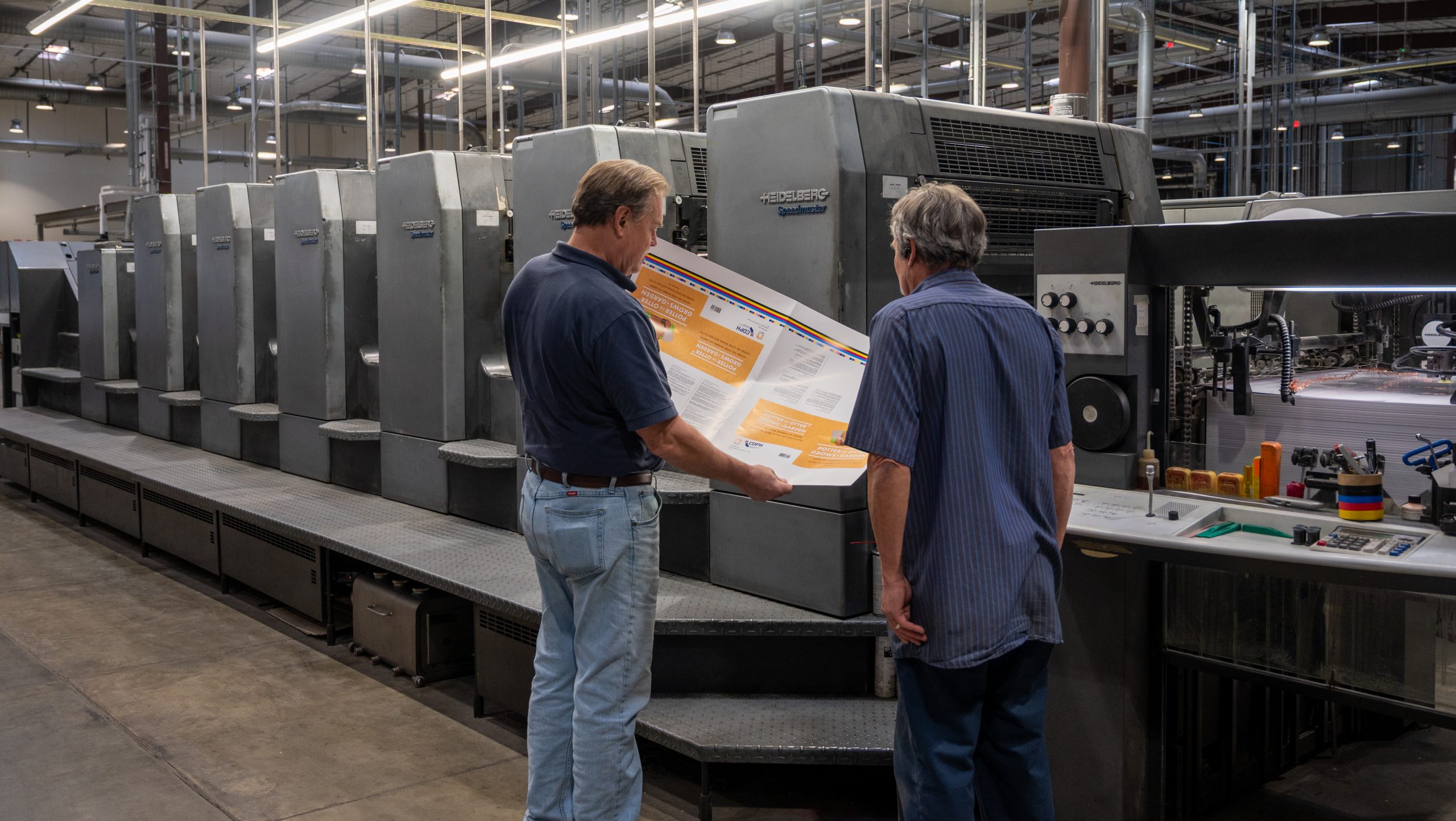
Michael Lubinskas (left) and Mark Chase review a press sheet for a California Department of Public Health booklet being printed on OSP’s six-color, 40" Heidelberg Speedmaster sheetfed press.
And in its secure digital print and mail facility in downtown Sacramento, OSP houses a host of digital presses: a Ricoh Pro C9500, two Canon VarioStream 7650 continuous-feed presses, two Canon 6320 black-and-white cut-sheet printers, and a 20" Ricoh Pro VC60000 production inkjet press, among other devices. That facility produces about 20 million impressions a year, and there are plans to add additional continuous-feed inkjet presses.
A Leaner, Smarter Operation
As vast as OSP’s operation is, it’s less than half the size it was a few decades ago. In the 1990s it employed 540 people and operated four Hantscho web presses and three Harris webs. But as demand dropped and digital technology advanced, OSP changed with the times, getting leaner and adding new services.
With $86 million in annual sales, today’s OSP provides a comprehensive range of services that support state agencies across the full lifecycle of documents and communications — from creation and design to printing, mail delivery, storage, fulfillment, and secure destruction. It even handles ADA remediation for electronic documents to make them accessible to screen readers.
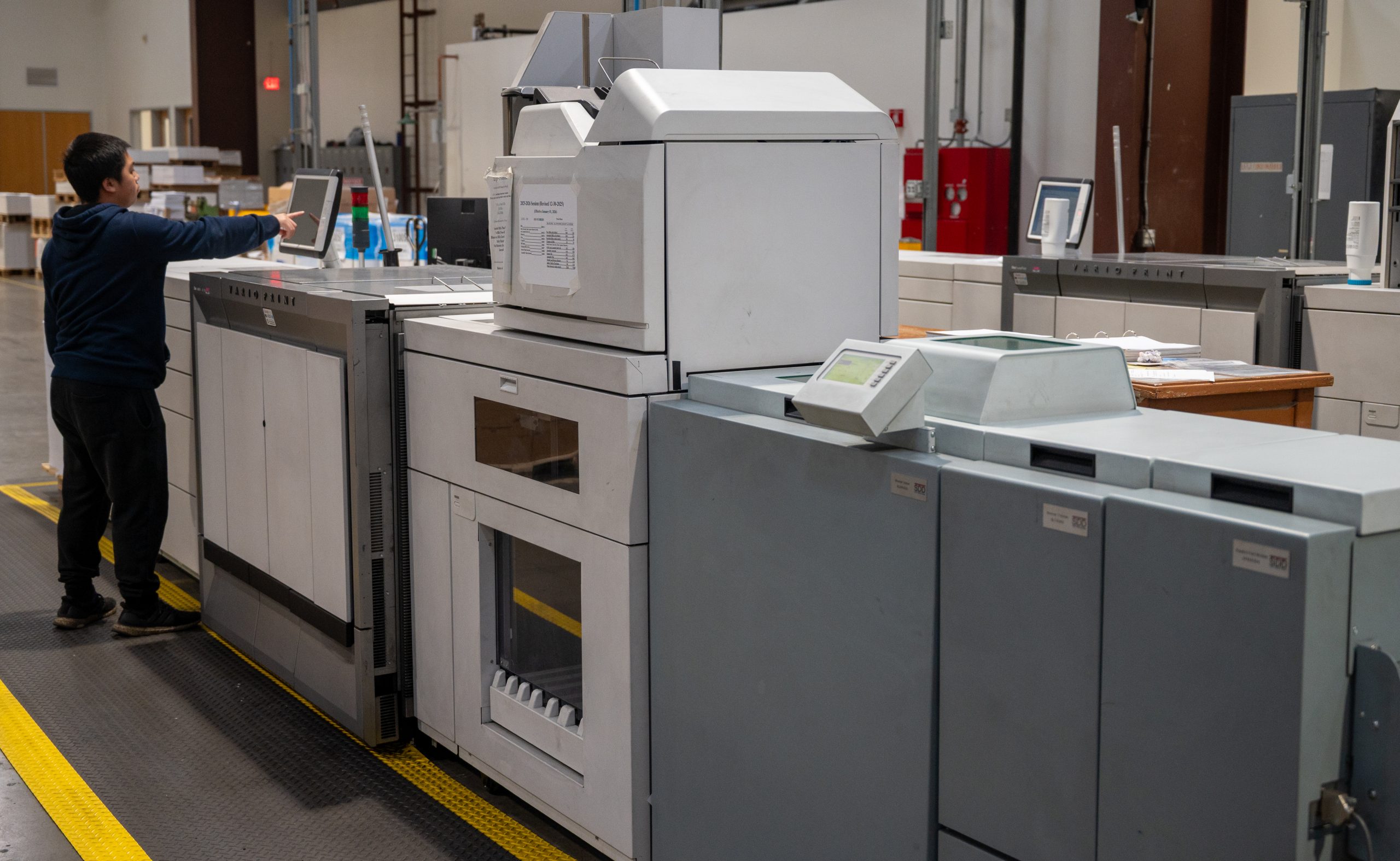
Anthony Vang runs one of OSP’s three Canon varioPRINT 6330 monochrome digital presses.
Guiding OSP as it responds to today’s demands while preparing for the future is State Printer Lou Butera, who came on board in August 2024. Under his leadership, OSP has been actively transitioning from maintenance mode to measured growth and modernization. The in-plant has made tangible gains in productivity and cost control, while focusing on organizational culture as the foundation for long-term success.
“Our vision is to be the printer of choice,” Butera proclaims. “We’re looking at how we keep more work in-house. And of course, to do that, we need to be competitive. We need to earn the business.”
With years of industry experience at companies like R.R. Donnelley, Direct Marketing Solutions, and Canon Solutions America, Butera brought a commercial printing approach to the government operation, which is part of the state’s Department of General Services.
Four Goals for Future Success
When In-plant Impressions met with him in his office a year ago, he outlined four key goals he had for OSP:
- Grow the business.
- Improve operations by reviewing equipment, software, workflow, and client interactions.
- Enhance OSP’s financial health by reducing costs.
- Develop the organizational culture by emphasizing integrity, teamwork, and continuous improvement.
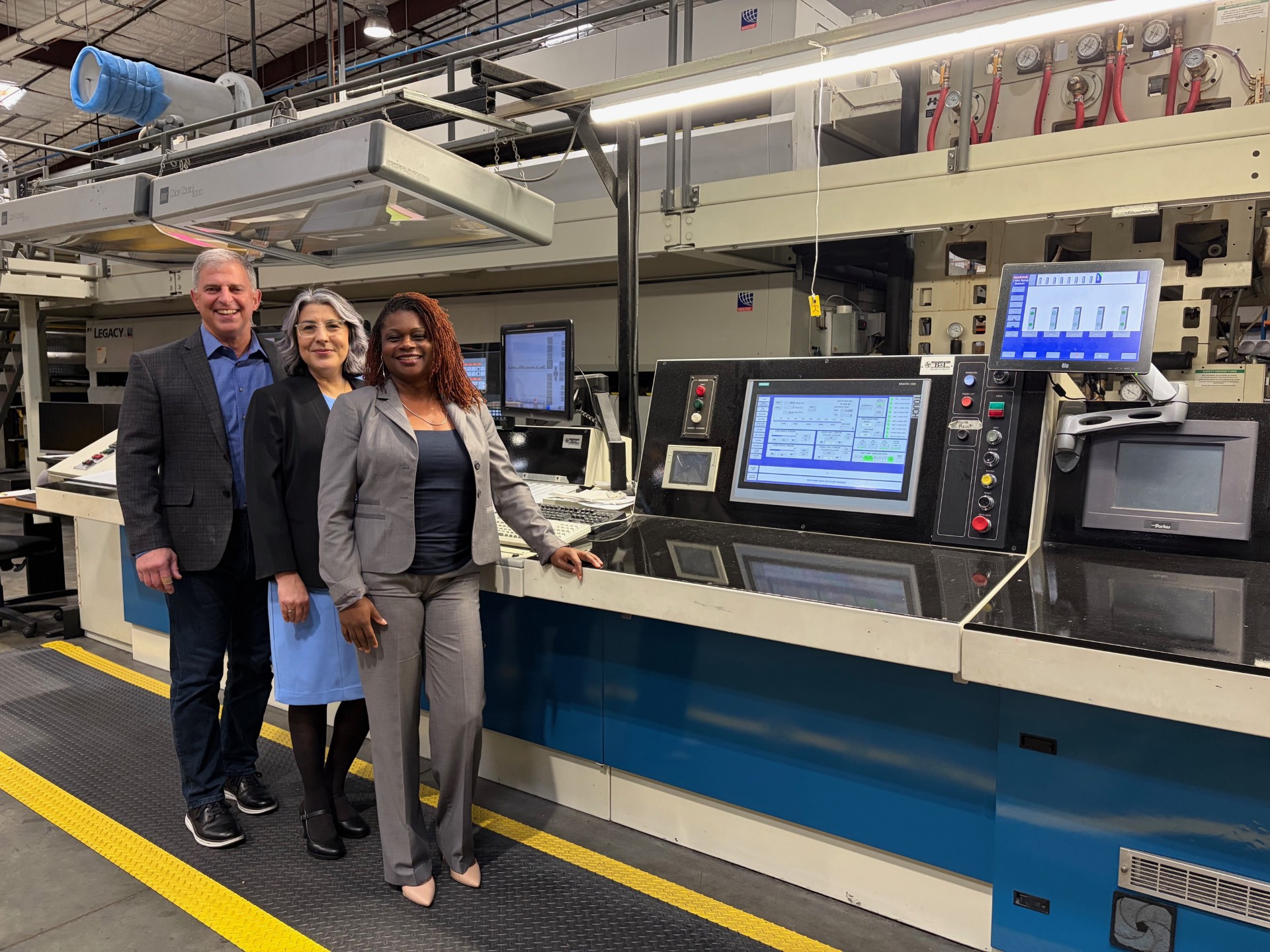
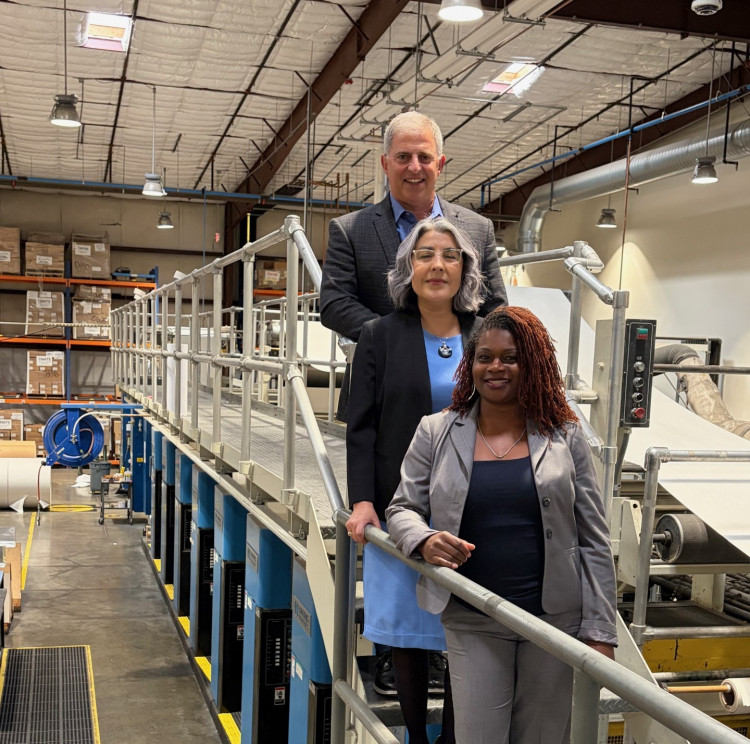
From left: State Printer Lou Butera stands with Assistant State Printer Norma Kreider and Administration Manager Tonya Said next to the in-plant’s eight-color Harris M-1000B web offset press.
We caught up with Butera recently to track OSP’s progress toward those objectives. He was quick to stress that he values the fourth goal more than the others.
“Cultural development is OSP’s number one goal,” he stresses. “A good strategy is much more effective with a solid culture to support the vision and efforts. The leadership team has been working hard to help shape a culture that embraces change. OSP is committed to helping the entire leadership team acquire the skillset to manage change, share ideas, challenge tradition, explore innovation, and hold us accountable to a high-performance level that is both measurable and supports our goals.”
He wants his staff to come to work with a desire to learn and continually improve. With this in mind, he sent three staff members to PRINTING United Expo 2024 to get a broad perspective on how the industry is changing. “They came back very motivated, very excited,” he says, imbued with “a shared vision of new workflows, new equipment, new technology, and fewer touches.”
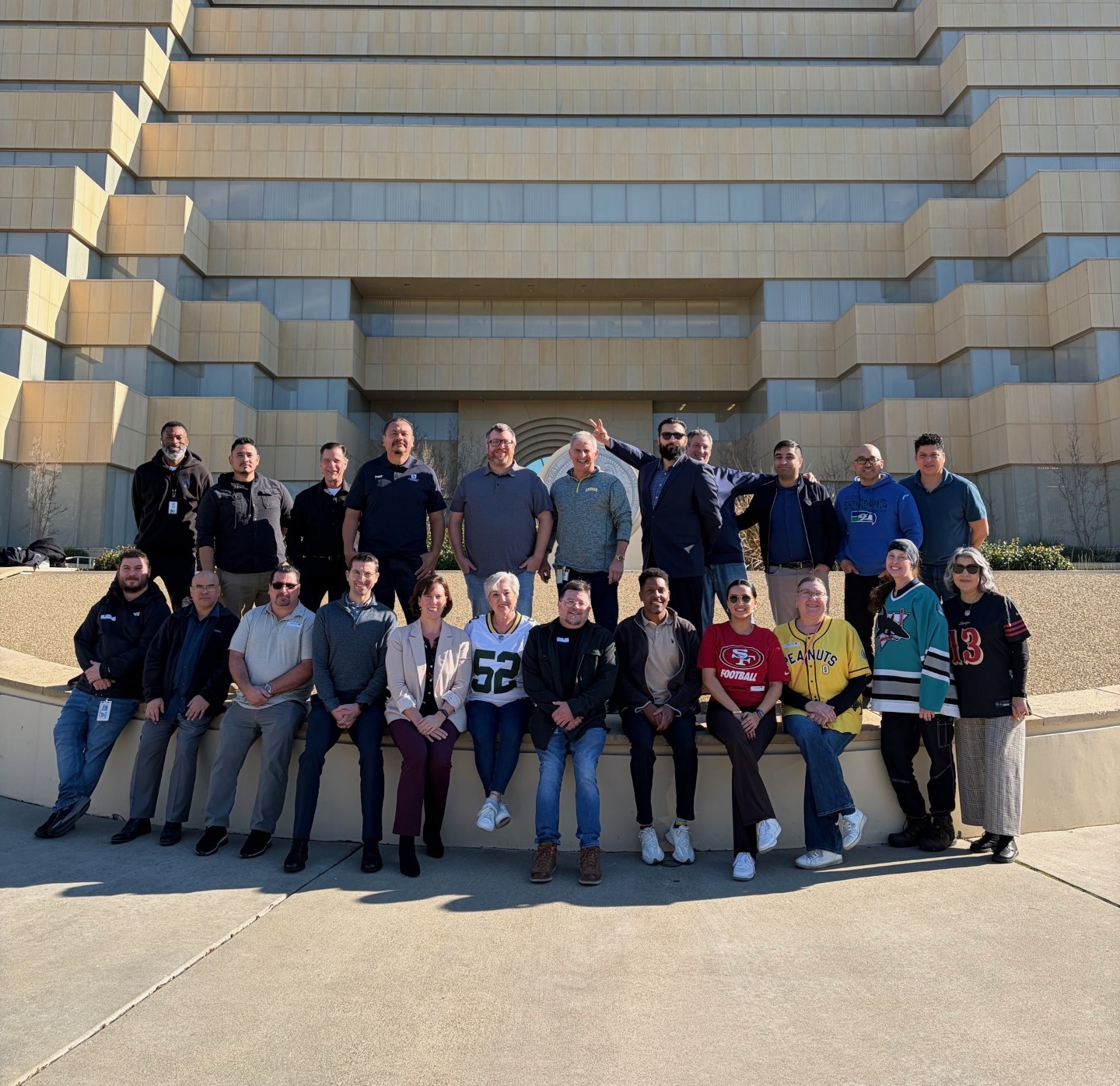
OSP’s senior leadership team poses outside the Ziggurat Building, which houses the Department of General Services. For the team-building meeting, many wore their favorite sports team jerseys.
This shared vision is helping to fuel OSP’s growth and operational improvement goals and move it away from the traditional state government acceptance of “business as usual.”
Bringing in Business
To support the goal of growing OSP’s business, Butera hired a new program manager to help capture business that had been released to private sector printers. Though a state mandate requires agencies to send their printing to the in-plant, OSP has opted to procure some of that work in the past. Thanks to the new program manager’s efforts, two new monthly print programs have been brought back in-house and more will be added, he says.
“OSP is also looking to deliver new digital and technology-driven services to other agencies,” Butera says. “This project is moving along nicely with support from both the DGS Enterprise Technology Solutions team and the California Department of Technology. The additional value-add services as well as onboarding more agency program work will provide additional revenue and growth for the OSP.”
To improve its business operations, OSP has created a “technology roadmap” that combines new print and mail technologies with process improvements to existing workflows.
“We have seen a 27% productivity improvement just with the printing and finishing of the voter information guides that are printed and bound in-house on our Harris M-1000 B web offset press,” proclaims Butera. “For this last special election, OSP was able to print and finish roughly 65% of the 14,500,000 voter information guides in half of the normal schedule. This is a record quantity in a shortened schedule. OSP’s goal is to provide faster and more customer onboarding, allowing for more growth.”

State Printer Lou Butera stands with Assistant State Printer Norma Kreider and Administration Manager Tonya Said on the in-plant’s eight-color Harris M-1000B web offset press.
OSP has completed its five-year asset purchase plan, which will be included in the five-year strategic plan now being finalized. Already OSP has added a sheetfed inserter in its digital print facility to increase productivity. Plans are in effect to replace the two Canon 6320s with one faster black-and-white toner press and to add new web inkjet presses over the next year.
Helping to guide OSP through its new equipment decisions has been a series of focused customer meetings.
“We have met with eight clients and established regular quarterly business reviews,” he says. “We have also incorporated several tours for clients that have never been through a printing plant.”
During these meetings, Butera and his staff ask customers for honest feedback about OSP’s performance and inquire about their future needs, to help the in-plant buy the right equipment and provide the right services to help them. It’s all part of Butera’s quest to earn their business and become their printer of choice.
To reduce costs and improve OSP’s financial health, Butera has focused on better equipment utilization, dynamic process improvements, and moving to more of a just-in-time workflow. He also sees ways to downsize OSP’s space needs by reducing the storage of both raw materials and physical records.
“There are some positive opportunities to help our cost structure by reducing our overall monthly building costs,” he notes.
Supporting Customer Success
All of these business improvement and workflow efficiency goals have one overriding intent: to support the success of state agencies. This support extends beyond ink on paper to other digital platforms, he notes, and by better partnering with agencies, OSP can educate them about these possibilities.
“Our goal is to pursue the vision of being ‘The Printer of Choice,’” Butera maintains. “This means providing excellence in all that we do and working with an attitude of ‘earning their business’ through timely communication and exceptional quality of finished products.”
By developing “top-tier, high-performing teams” focused on finding efficiencies and keeping pace with technology changes, he says, OSP will continue to improve in the years ahead.
“The best strategy and objectives mean nothing without engaged and motivated teams to support the vision,” he says. “We will make it easier for our customers to work with us and to reduce our production cycle time by investing in new technologies” — including additional non-print services.
“And yes,” he concludes, “there will be a place for AI in the workflow and customer engagement process.”
Bob has served as editor of In-plant Impressions since October of 1994. Prior to that he served for three years as managing editor of Printing Impressions, a commercial printing publication. Mr. Neubauer is very active in the U.S. in-plant industry. He attends all the major in-plant conferences and has visited 200 in-plant operations around the world. He has given presentations to numerous in-plant groups in the U.S., Canada and Australia, including the Association of College and University Printers and the In-plant Printing and Mailing Association. He also coordinates the annual In-Print contest, co-sponsored by IPMA and In-plant Impressions.