


Promo Products: A Great Opportunity for In-plants

Selling promotional products has been a great business for Texas Tech University Health Sciences Center’s (TTUHSC) in-plant. Last year, promo product sales brought in $872,000 in revenue for the 28-employee Lubbuck, Texas, operation — nearly a third of its 2025 annual sales of $2,927,445.
But for Debbie Cate, managing director of TTUHSC General Services, the biggest impact of promo products isn’t just the revenue, it’s the way promo has changed how people on campus view her operation.
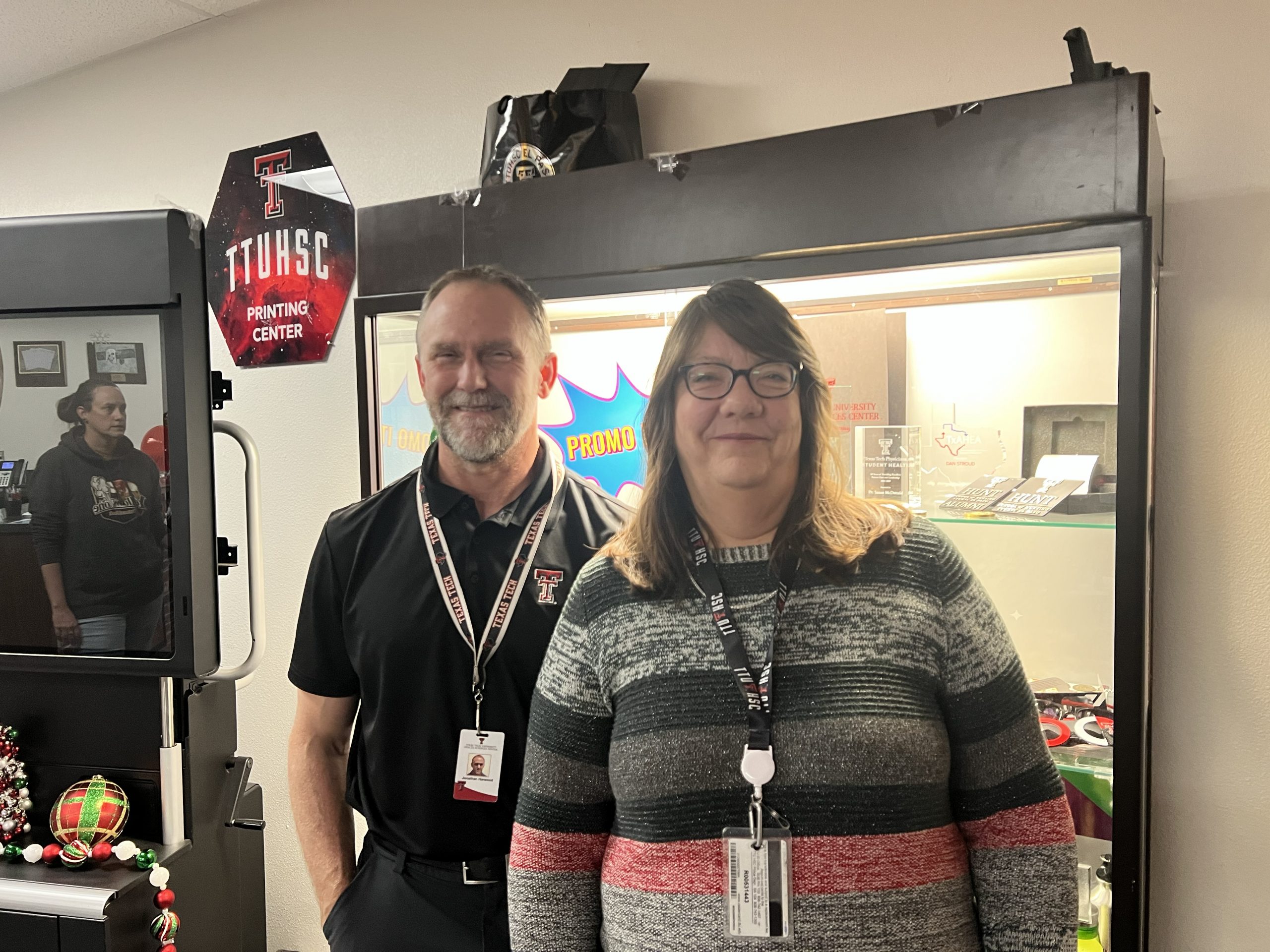
Jon Harwood and Debbie Cate stand in front of a promo products display case in the lobby of the TTUHSC Printing Center.
“It’s made people a lot more aware of us,” she says.
She has put display cabinets in other areas she oversees, like mail and vehicle rental, to show off promo products.
“Everybody who walks in the door goes, ‘oh, I didn’t know y’all did that,’” she says.
This has brought the in-plant more printing business and more prestige on campus.
A Growing Market
Across the country, promotional product sales are growing by leaps and bounds.
“In 2024, industry sales reached $26.6 billion,” said Joan Miracle, executive director of corporate accounts at Advertising Specialty Institute (ASI), speaking at a session during PRINTING United Expo. “That’s a massive number — and a massive opportunity for printers looking to expand.”
In-plants have been tapping into that market for years. In a 2024 In-plant Impressions survey, 20% of respondents said they were selling promo items. It not only generates revenue, it entrenches the in-plant deeper into the organization’s culture, increasing its value.
At TTUHSC’s in-plant, selling promo products has become a major driver of awareness, revenue, and campus engagement. There is so much business, the in-plant has a full-time person, Jon Harwood, handling it. In November, the slowest time of year, he had 46 active orders; in July he handled 186 orders.
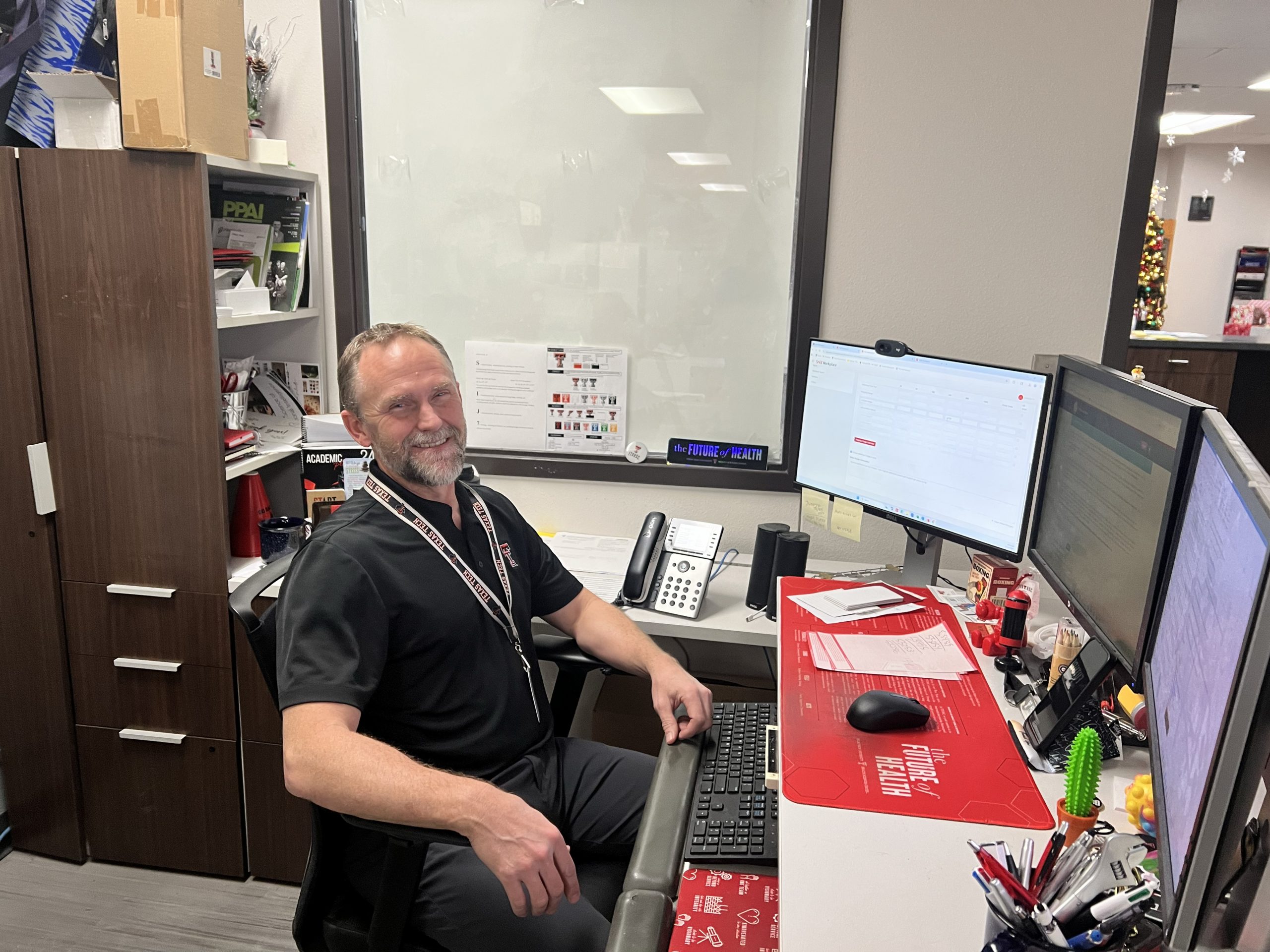
Summer is a busy time for promo products. In July, Jon Harwood handled 186 orders.
“In the summer I usually pitch in and help him,” Cate says. “And it almost becomes my full-time job.”
The profit is high enough to pay Harwood’s salary and benefits, and still have money left to buy equipment. The in-plant charges a 27% markup on promo items – less than the 40% industry standard, Cate says – and still saves customers money and time over ordering it themselves.
“They love not having to do purchase orders,” she says. Customers can browse available promo items on a site linked to the in-plant’s homepage, request quotes, attach artwork, and place their orders. These come to the in-plant, which vets them, ensures logos are accurate and artwork meets quality standards, and then places the order. Since the in-plant already monitors branding for print jobs, it has a standard agreement with university communications and marketing allowing it to do this for promo orders.
“Big promo companies like 4imprint, if you try to order from them with a [Texas] Tech logo, they're going to go back and go through athletics, get the permission, the royalties, all of those kinds of things,” Cate says. Ordering through the in-plant avoids those delays.
Though the in-plant has the promo ordering process down to a science, sometimes its reputation for quick-turnaround printing creates unrealistic expectations, Cate says.
“People are so used to us being so fast on printing – our turnaround time is very, very fast – and so they will often wait and say, ‘oh, I have an event next week. I need promo items,’” she relates. Since those often take a little longer to produce, Cate has come up with a solution.
“We actually have a list of items that we've compiled that people can print last minute,” she says, such as stickers, coloring books, mouse pads, and notebooks. These can give customers something promo-related to give away at their events, while creating more print business for the in-plant.
Promo Generates Print Business
Being able to offer promo items has brought “quite a bit” of new print business to the in-plant, she says.
“Events are huge because we can print the ‘save the date,’ the invitation, the program, and then come up with a bag or whatever it is they're giving away, and do the whole thing,” she says.
Some of the most requested promo items by TTUHSC customers are lanyards, bags, pens, and stress relievers, Cate says. Customers looking for more unique items have ordered selfie lights, security covers for phones and laptops, license plate holders, and beanies.
“We do an ink pen that's the shape of a cactus,” she adds.
Nationwide, says ASI’s Miracle, “T-shirts are number one, representing 16% of all sales. Then it’s drinkware, polo shirts, caps and headwear, then bags.”
Some current promo product trends she’s seen are tech products with sleek designs, smart luggage tags, phone accessories, sustainable products made from recycled or eco-friendly materials, and branded whiskey decanter sets.
Becoming a Distributor
Though TTUHSC’s in-plant has printed flash drives on its flatbed printer using a jig, it does not print a lot of promo products itself. The shop became a promo products distributor through SAGE, a national organization that, like ASI, serves the promotional products industry. As a distributor the in-plant can order products directly from manufacturers. To get certified as a distributor it had to show SAGE that it did work for customers outside of TTUHSC.
“We have always been able to print for nonprofits,” she says, so she gathered invoices to prove that, and the shop was accepted as a member.
Another way in-plants are getting into the promo products business is through the In-plant Printing and Mailing Association’s partnership with Swag Solutions, a promotional products e-commerce agency, which provides an ordering website, handles the logistics, and shares revenue with the in-plant.
“If you don't have staff that could do the promo business, then it's a great way to get started,” says Cate, “but their pricing is a lot more.” Her in-plant saves TTUHSC customers more money and generates more revenue, she contends, by handling the promo business itself. Plus, the process isn’t always straightforward, she notes, and she prefers having her team involved when challenges arise.
“It's not as simple as just placing your order and giving the vendor the artwork because there is going to be a lot of back and forth,” she says. “The vendor may be out of stock in that color and then you have to go back to your customer and change everything and that may affect your artwork.” Managing proofs, payments, refunds, and taxes adds even more layers of complexity to the process. She created a database to help her track all those variables for each job.
“Our next challenge is going to be the tariffs,” she says. “We have to have justification if we're using a foreign vendor.”
Still, her best advice for fellow in-plants is this: “Just start.” Take it slowly and build the business. Selling promo products is an excellent service for in-plants to offer, she says.
“Printers already have a competitive advantage,” ASI’s Miracle says. “You know branding. You know deadlines. You know quality. You just need to start offering the products your clients already want.”
Bob has served as editor of In-plant Impressions since October of 1994. Prior to that he served for three years as managing editor of Printing Impressions, a commercial printing publication. Mr. Neubauer is very active in the U.S. in-plant industry. He attends all the major in-plant conferences and has visited 200 in-plant operations around the world. He has given presentations to numerous in-plant groups in the U.S., Canada and Australia, including the Association of College and University Printers and the In-plant Printing and Mailing Association. He also coordinates the annual In-Print contest, co-sponsored by IPMA and In-plant Impressions.
 How Selling Promo Products Can Expand Your In-plant's Business
 5 Insights From ASI’s State of the Industry Report
 Could Direct-to-Object Printing Enhance Your Productivity and Profitability?
 Top 10 Things to Know to Move Into Promo
 Class is In Session for Promotional Products
 PRINTING United Alliance Launches Promo Impressions

