


Ellen Abbey: A Lasting Legacy of Customer Service

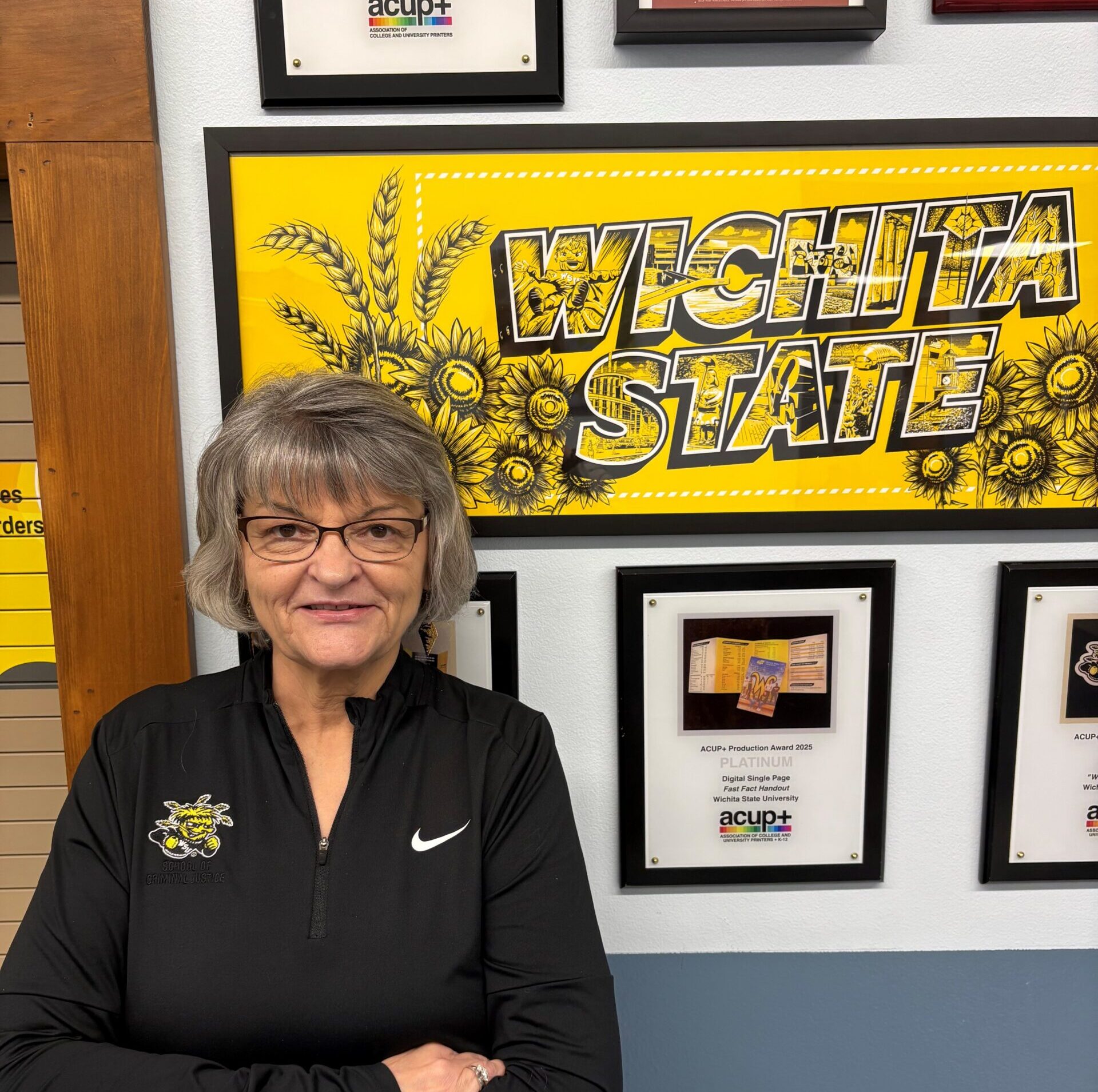
Ellen Abbey
Ellen Abbey might be the director of Auxiliary Services, Postal, Printing & Promo Solutions, at Wichita State University today, but she began her higher-ed career in a far humbler role. In 1979 she took a job as an accounts payable clerk at the Wichita, Kansas, university.
Over the next 20 years, Abbey’s accounting expertise and close collaboration with the university’s budget director positioned her for a move into Central Services when an opening emerged in late 1999.
“My boss — the woman who hired me — was the budget director for the university,” Abbey recalls. “She and I worked very closely together on budgets and had gotten to know each other. When the position came open, she asked me to apply, and so I did.”
Her boss wanted someone with an accounting background to replace a departing supervisor who didn’t understand budgets very well and was reliant on her for that.
“So she just basically said ‘okay, here’s this group. I need someone to manage them. Here you go,’ and just left me to it," Abbey says. "And that’s funny because the way I started in Fine Arts is, ‘hey, we need somebody to handle our budget.’”
Learning the Language
Fortunately, Abbey didn’t come into the position without any print resources. Her husband worked in commercial printing. She jokes that previously when he talked about his job, it would “just go in one ear and out the other.” But after she accepted the role, suddenly she started having more meaningful conversations about print-specific topics. Before, she notes, “it didn’t mean anything to me. Now it all had meaning.”
Though her husband was an “offset guy,” digital printing was starting to make a big splash in the print world at that time. And while there were certainly bumps in the road and strong opinions about offset and digital printing, Abbey paid close attention to what digital could actually offer, and pushed her team to take advantage of what the shop already had.
“What I learned was that my crew was using this equipment as if they were copiers, rather than using them digitally,” she says. “And so I started pushing then for digital submission, and to start using this equipment in the way that it’s intended and get the full use out of it. I mean, we’re paying a lot of money for it. Let’s use it. Let’s go for it.”
That quest to use digital technologies to improve the in-plant’s offerings has never stopped. Even today, Abbey is always looking at what can be improved, added, or tweaked to ensure the shop (which is now called Shocker Printing and Promo Solutions) is offering the best quality and meeting the expectations of staff and students.
The quality of her in-plant’s work has received national attention. The shop was honored with one Platinum and two Gold awards in the 2025 ACUP+ Awards competition, sponsored by the Association of College and University Printers. Abbey was quick to promote this success to campus.
“We’ll put it in the news when we get an award, so it brings attention to say, ‘hey, we’re not just a copier. We print, and we do really good work and we’ve been recognized for our work.’ And I hope that that helps to keep the print shop alive for many, many years,” she says.
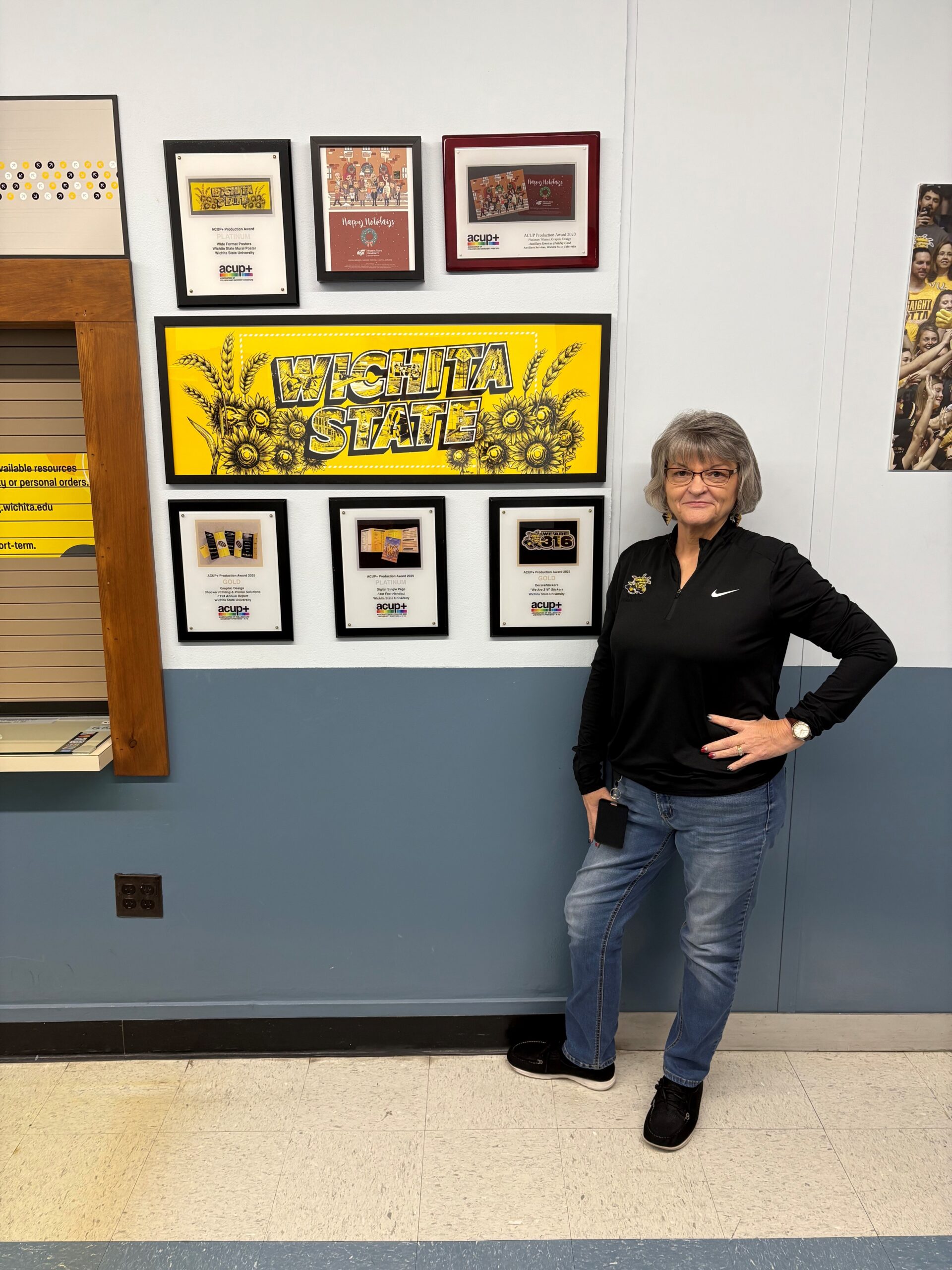
Ellen Abbey shows off some of her in-plant’s ACUP+ awards. | Credit: Wichita State University
Abbey is a member of both ACUP+ and the In-plant Printing and Mailing Association and has attended conferences several times. She enjoys sharing insights with other in-plant managers around the country and credits them with helping her build her knowledge base.
In 2022, one of the services the in-plant added was promotional product sales, something Abbey felt strongly about. In-plants, she says, have to bring value to their parent organizations, but beyond that, “my biggest argument [in support] of our operation — even bringing in promo — is that we need to control our brand. Our vice president of strategic communications is on board with me on that, and believes we are the keeper of our brand. We cannot trust outsiders to love our brand as much as we do.”
Wide-format and apparel printing are two other areas Abbey has seen take off, with wide-format in particular doing well.
“We just love that,” she says.
Stickers have also proven to be a popular application on campus.
“We do outdoor banners and stuff [like] that, but stickers, oh my goodness. Every year since we’ve been doing it — for three years —the numbers have doubled ... on the number of stickers that we sell,” she notes.
‘Four Years of Hell’
One bump in the road, and what Abbey calls “the biggest mistake of my career,” was hiring an outside vendor to manage the print center in 2011. What followed, she says, were “four years of hell.”
“The biggest thing I learned … is that I needed to have control,” she explains. “I couldn’t relinquish control to an outsider. No matter how much money we were paying them, they were not going to be loyal to WSU, the customer. They were going to be loyal to [the vendor.]”
When that agreement ended in 2015, Abbey regained control of the in-plant and brought several former contractors onto her staff — people who shared her passion for customer service. From the beginning, she has hired with that priority in mind, and she credits that philosophy — and the team it built — as the greatest success of her career.
“I hire people based on that more than I hire on knowledge of printing,” she says. “There are things we can teach you and things that are just part of you, and that passion for customer service is something that’s just part of you. If you don’t have that, you’re not going to work well here.”
Moving On
Having laid a strong foundation for customer service, Abbey hopes this legacy will endure. She plans to retire in August 2026, after 47 years of service at the university. Her husband is already retired, so she looks forward to spending more time with him and with the rest of her family.
“I have one child and he married a few years ago. They’ve got two children now,” she says. “My husband and I are really looking forward to being full-time grandparents.”
While the couple might do some traveling, Abbey is really most excited about being able to spend more time with her grandchildren and being a part of their lives as they grow up. That said, she also enjoys making beaded jewelry, and will make time to do more of that as well.
As for her job at Wichita State’s in-plant, she is planning to make a clean break.
“I love this campus and this community, and it matters to me,” she says. “But I’m going to try and walk away because what I’m afraid of is that I’ll get my feelings hurt if something changes dramatically or they take a different course. So I just think I will probably need a clean break and just get on with something else.”
As she looks back at her career and the in-plant she helped grow and change, Abbey offers some advice to the next generation of managers.
“You need to get to know your employees, and you need to know what goes on in your shop every day,” she says. “You need to get in there and be involved with it. Don’t sit in your office. You’ve got to talk to the customers, the end users, and understand what it is they want, need, and care about. You have to be involved.”
Toni McQuilken is the senior editor for the printing and packaging group.
 New Creaser Improves Quality, Speeds Production in Wichita
 IPMA Appoints Erica Derrington to Board of Directors
 Becoming California's 'Printer of Choice'
 File Room Job Launches 32-Year Print Career
 Omaha Public Schools Bets Big with New Investments
 GPO Supercharges Operation With New UV Offset Press

