


Honoring D-Day Through Print

On D-Day, June 6, 1944, 82 years ago, more than 150,000 Allied troops launched the largest amphibious invasion in history, landing on the beaches of Normandy, France, to liberate Nazi-occupied Western Europe. This began the final push to defeat Germany, marking a turning point in World War II. Here is how one in-plant honored the soldiers who participated in the D-Day invasion.
Complex wide-format projects can be intimidating for any in-plant. They stretch equipment, skills, schedules, and confidence. But they can also be some of the most rewarding opportunities an in-plant will ever take on.
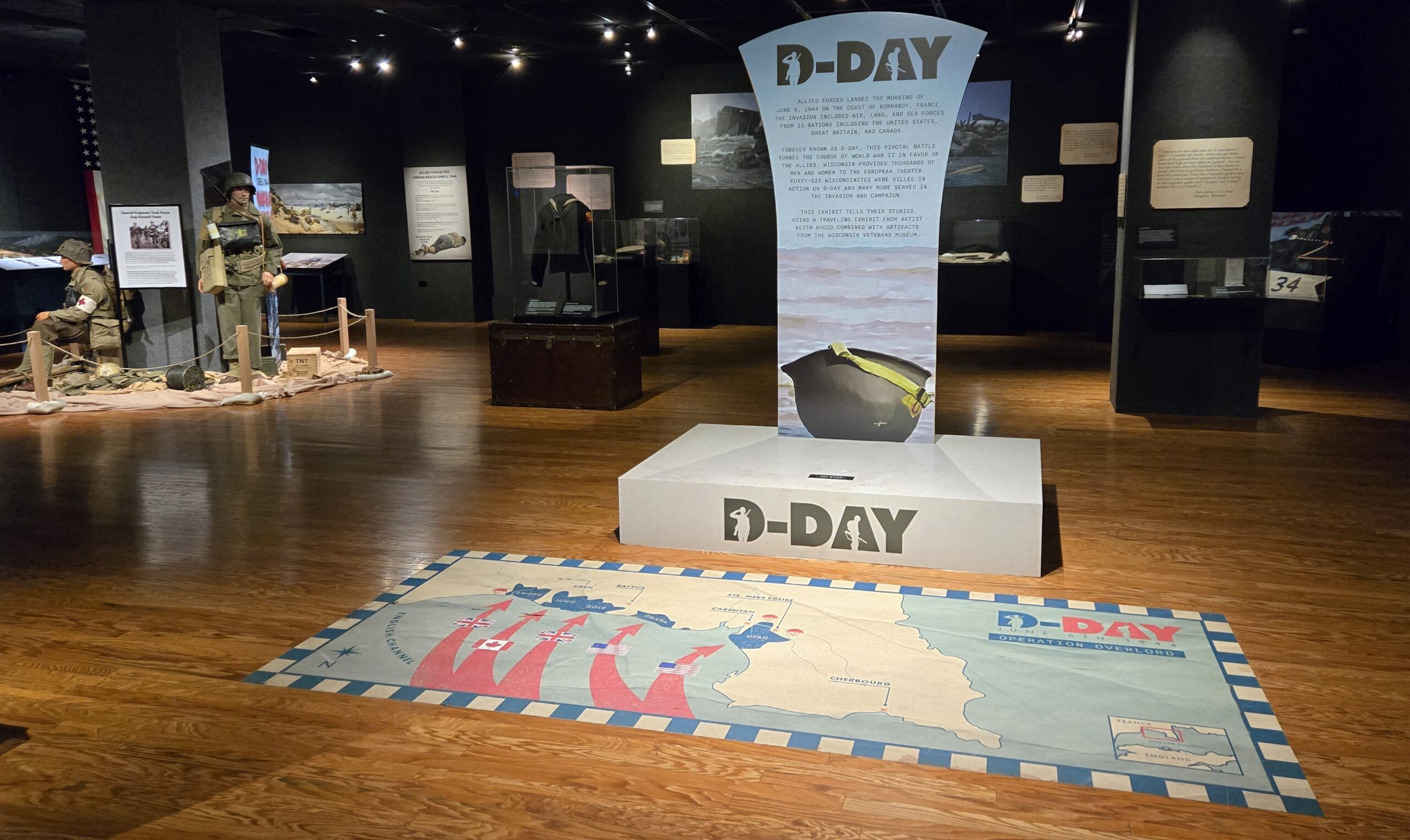
Part of the D-Day exhibit the in-plant produced for the Wisconsin Veterans Museum.
For example, the State of Wisconsin’s Bureau of Publishing & Distribution played an integral role in creating an exhibit for the Wisconsin Veterans Museum to honor the 80th anniversary of the end of World War II. With its Mimaki JFX200 flatbed printer and Roland TrueVIS roll-fed printer, the 50-employee in-plant printed several graphics for the D-Day exhibit, which opened in July.
The in-plant printed a 125x53.75" mural for the exhibit. It also printed 54 panels of varying sizes using white ink on black PVC to describe portions of the exhibit, along with 35 large graphic panels and some banner stands. Adhesive materials were printed and contour cut by operators Ryan Nelson and Israel Dunn, who took special care to adjust the cut depth to ensure clean and accurate weeding.
Then a team of in-plant employees installed the mural, which was split into two panels with a 2" overlap. They carefully positioned the mural and the overlap to avoid gaps and guarantee a cohesive image.
The full exhibit includes four dioramas showing the struggle on the beaches of Normandy. Combined with stories and artifacts of Wisconsin men who survived the D-Day invasions, this exhibit presents the battles from the perspective of the soldiers, sailors, and airmen who were there.
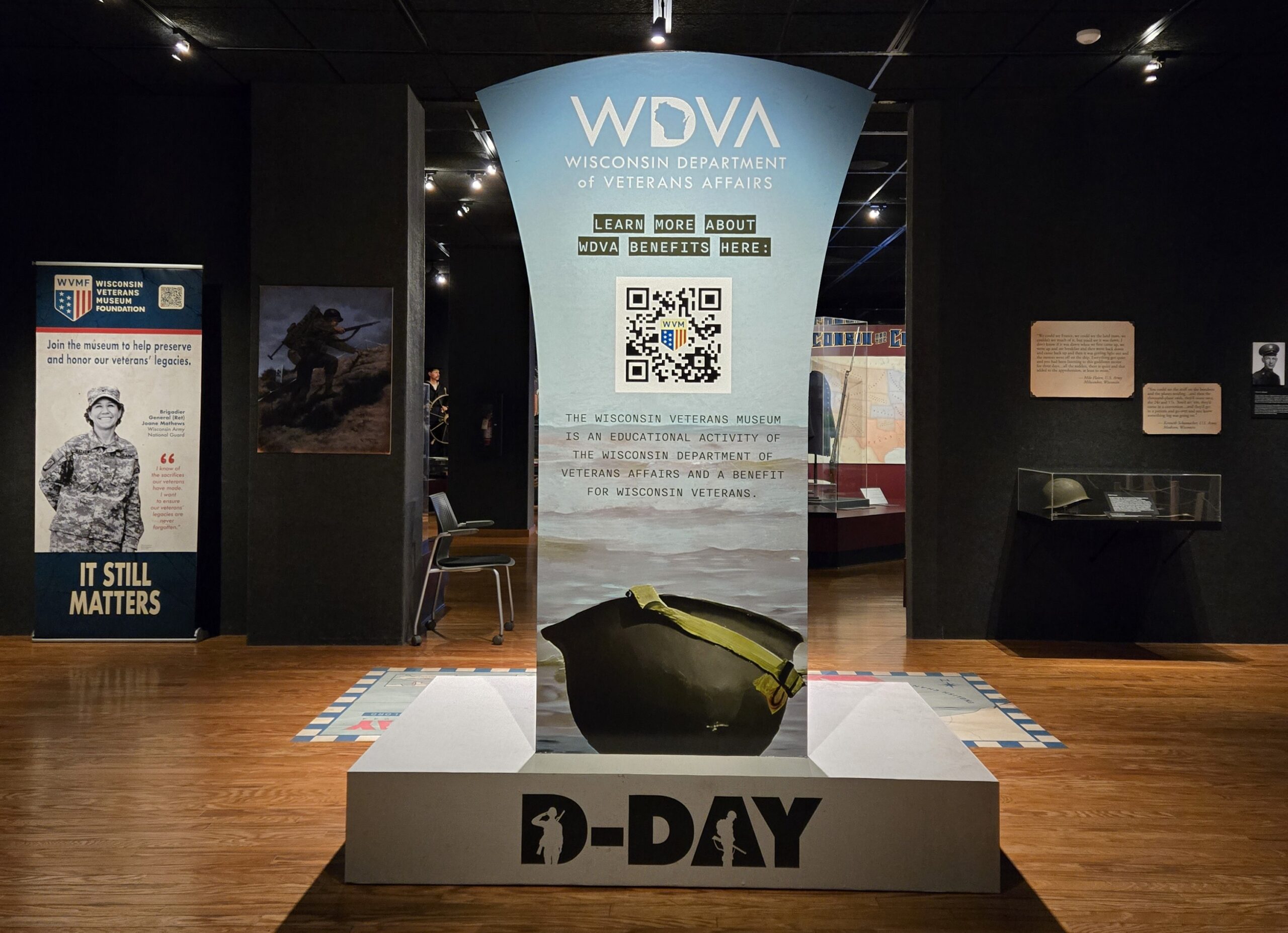
Part of the D-Day exhibit the in-plant produced for the Wisconsin Veterans Museum.
In-house Advantages
Printing this project in-house not only saved money over what outside vendors would have charged, it allowed the in-plant to verify that the color, quality, weeding, and transfer tape for installation all met its standards. It also gave staff the flexibility to make adjustments while working through the project.
“It’s nice to just be able to adjust on the fly,” notes Alicia Guzmán, Publishing Services supervisor at the State of Wisconsin Bureau of Publishing & Distribution. “Being able to do it all in-house just gives you so much more ownership over the quality and the final production of the pieces, with a lot less … turn time if there was an issue.”

She said the in-plant was proud to print this complex project in-house to honor the soldiers who participated in D-Day. But also, tackling a complex project like this gave the in-plant a chance to show off its capabilities.
“Part of what we’ve been trying to do is grow our wide-format,” she says. “So really being able to show that off through an entire exhibit for a museum [was] an excellent way to accomplish that for us.”
The in-plant’s successful completion of this project has already paved the way for additional work from the Department of Veterans Affairs, Guzmán says.

“It definitely increases our value,” she observes. “When we want to request additional equipment or upgrades, being able to speak to the work that we’ve done for departments, museums, exhibits, really helps us along the way to further get what we’re … asking for in the future.”
And beyond that, she adds, doing complex projects like this is a lot of fun.
“They’re just cool and exciting to do,” she says. “It’s kind of nice to just see what you can accomplish. Sometimes it’s just cool to be like, ‘Man, we made that.’”
- Categories:
- Digital Printing-Wide Format - Flatbed
Bob has served as editor of In-plant Impressions since October of 1994. Prior to that he served for three years as managing editor of Printing Impressions, a commercial printing publication. Mr. Neubauer is very active in the U.S. in-plant industry. He attends all the major in-plant conferences and has visited 200 in-plant operations around the world. He has given presentations to numerous in-plant groups in the U.S., Canada and Australia, including the Association of College and University Printers and the In-plant Printing and Mailing Association. He also coordinates the annual In-Print contest, co-sponsored by IPMA and In-plant Impressions.
 The Wide-Format Summit: An 'MBA in Wide-Format'
 Options or Essentials: Making Sense of Wide-Format Technology
 Increasing Opportunity with Expanded Color Sets
 New iLEARNING+ Course Opens Up Opportunities in Si
 Cajon Valley In-plant Brings Wide Range of Value to School District
 2026 International Sign Expo Delivers New Solutions, Strategies

