Inkjet Refresh Boosts Versatility, Capacity in Hemet

When Hemet Unified School District’s Publication Center installed two Xerox inkjet presses in late 2017 – a Brenva HD cut-sheet and a Rialto 900 roll-to-cut-sheet – it became one of the first school district in-plants to venture into production inkjet. That decision led to a soaring curriculum-printing business, and brought significant cost savings to the Southern California district, about 90 minutes southeast of Los Angeles.
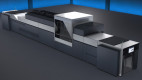
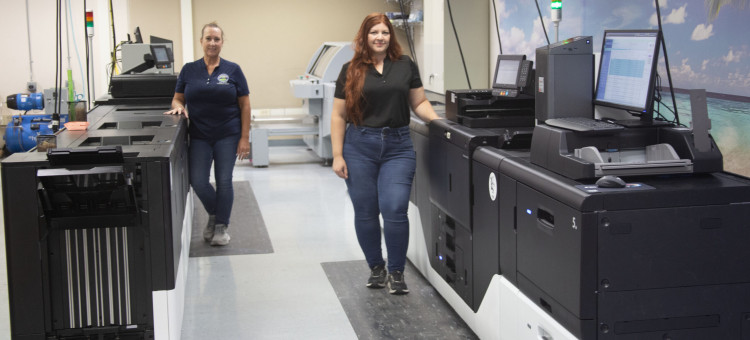
The years since have brought some changes to that inkjet lineup. The shop swapped the Brenva with a Baltoro in June of 2020. Then, in May it replaced the Rialto with a pair of Kyocera TASKalfa Pro 15000c inkjet presses with high-pile stackers and in-line saddle stitchers.
“The versatility of the Kyoceras over the Rialto was significant,” says Manager Lee Christiansen. Where the Rialto was limited to 8.5x11" and 8.5x14" pages, the new printers can handle 11x17" and 12x18" pages as well.
“The image quality is actually, in my opinion, much better than the Baltoros,” he adds.
While the Rialto printed at a higher speed than a 15000c, he says, “two of them now gives me more capacity than I had on the Rialto.” Since installation, the pair has averaged 1.38 million impressions per month.
“Right now we have extended our hours,” Christiansen says. “We’re running all three machines [including the Baltoro] at full capacity to get all the work out.” The shop is so busy he brought in three full-time interns, boosting staff size from nine to 12.
Though each 15000c is 23.5 ft. long, the shop was able to fit them both in the space formerly occupied by the Rialto. A single operator can run both inkjet presses. Having two 5,000-sheet stackers on each allows them to run longer unattended.
The Baltoro, with an in-line perforator and square back binder, produces book sets for schools, including planners and educational materials. Operators can use a Xerox Iridesse to print gloss covers, then feed them into an in-line Bourg Sheet Feeder where they’re combined with inkjet-printed pages to create a finished book. The Kyoceras mostly print uncollated “class sets,” he says, which are single-page handouts. This flexibility lets the in-plant provide exactly what teachers need to do their jobs.
“Being able to provide it in the way that the teachers requested it is what sets us apart,” Christiansen says. “Our job’s to provide support for them in a way that helps them do their job: teaching students.”
He credits his attendance at the 2024 Inkjet Summit with bringing Kyocera onto his radar.
“I didn’t know much about Kyocera prior to Inkjet Summit, so having the opportunity to sit down with the vendor at the Inkjet Summit was significant for me,” he says. “It’s what started me down the path of the decision to purchase the two.”
Bob has served as editor of In-plant Impressions since October of 1994. Prior to that he served for three years as managing editor of Printing Impressions, a commercial printing publication. Mr. Neubauer is very active in the U.S. in-plant industry. He attends all the major in-plant conferences and has visited 200 in-plant operations around the world. He has given presentations to numerous in-plant groups in the U.S., Canada and Australia, including the Association of College and University Printers and the In-plant Printing and Mailing Association. He also coordinates the annual In-Print contest, co-sponsored by IPMA and In-plant Impressions.