Wide-Format Summit Wraps Up in Florida

The following article was originally published by Wide-format Impressions. To read more of their content, subscribe to their newsletter, Wide-Format Impressions.
The 2025 Wide-Format Summit came to a close this week in Aventura, Florida. Presented by PRINTING United Alliance and Wide-Format Impressions, the fifth annual event focused on automation and best practices for taking wide-format businesses into the future. (Read our recap of day one here.)
Tuesday's first general session, presented by Lisa Cross, principal analyst with Alliance Research, cited data from three recent research studies to present an illuminated view into whether (or how) wide-format companies are automating their processes.
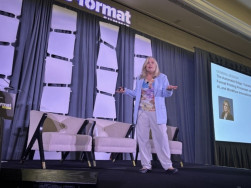
Lisa Cross, principal analyst with Napco Research
Cross discussed the benefits and challenges of automation in wide format printing. Key points of Cross’s presentation included the role automation plays in boosting productivity (75%), meeting customer demand (71%), and staff satisfaction (56%).
Despite the stated importance of automation among wide-format producers (84% say it is essential for competitiveness), only 49% of respondents reported having significant automation in place. For those seeking success in automation, Cross emphasized the need for strong leadership and strategic alignment to effectively leverage automation.
She added that some of the most common barriers to success in automation are workflow complexity and systems integration. "Lots of times," she said, "we automate one part of our organization and not the others, and then we go to update another part of the organization, we find that systems aren't always competitive."
Streamlining Wide-Format Processes

From left: Kevin Breckenridge, Ian Scott, Dan Marx
Following Cross's presentation, Dan Marx, content director of Wide-format Impressions, took to the stage for his panel, "Streamlining Wide-Format Production." Marx was joined by Ian Scott, COO of Convergent Print Group, and Kevin Breckenridge, large-format manager for Data Communications Management. The three discussed the challenges they're currently facing in the industry, like color proofing and matching for wide-format printing, difficulty in automating finishing processes, labor costs, and how the evolution of automation software has helped reach the goals of faster work, waste elimination, and profit maximization.
Addressing Attendee Questions
Marco Boer, VP at I.T. Strategies, took the stage for a second time during the events to address a series of ten key "burning questions" submitted prior to the event.
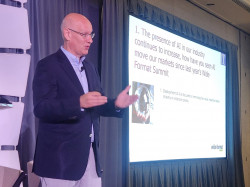
Marco Boer, VP of I.T. Strategies
The fast-moving presentation included Boer's take on artificial intelligence and how it will affect the wide-format space, automation and robotics, the ongoing emergence of the decor printing opportunity, and how levels of quality may provide opportunity to take on more work from certain customers.
Addressing wide-format equipment trends, Boer says he sees producers keeping their systems for longer periods. "We used to say that the average piece of white format of equipment would last somewhere around eight years," he shared. "That's now stretching into nine or even 10 years, because the equipment is more reliable, right? We've gotten smarter over the last 30 years. The only thing that we're finding is that we're adding upgrades to things."
This is the second year Boer has answered audience-submitted questions, and last year's presentation resulted in the ten-part Mondays with Marco series.
The day was also punctuated by a series of case studies presented by summit sponsors and the event's unique one-to-one meetings, which allow deep, valuable exchange between sponsors and attendees. The day concluded with a boisterous "casino night" filled with voices, music, and fortunes of fake money.
Final Day of Summit
To get things started Wednesday, Leana Becker, a seasoned interior designer with more than 25 years of experience and CCO of Western Sensibility, took the stage to discuss how digital print technology is transforming the way the industry designs meaningful, sustainable products and processes, and painted a great picture of the potential harmonious relationships between printers and designers.
Her presentation detailed the evolution of digital printing in the interior design industry, particularly in textile printing. Throughout her session, Becker really drove home the fact that digital printing offers a valuable toolkit for designers seeking to break new ground in customization and creativity. By better understanding and embracing this technology, Becker said designers can find new ways to solve aesthetic and logistical design problems. She said there's still a lot to learn and implement as the landscape of digital printing continues to grow, but along with that, there are also many opportunities to innovate.
"We're taking digital print technology that we meant for other sectors of business, and we're adapting it for our use, so we're able to create something really special," Becker said.
The Changing Regulatory Landscape
Following the remainder of the case study presentations, general sessions resumed for the afternoon, and to get things started, Gary Jones, vice president of Environmental, Health, and Safety Affairs for PRINTING United Alliance, took the stage to discuss how PSPs should approach and address regulatory mandates. The session explored the impact that significant regulatory changes, policy shifts, and enforcement trends have on the day-to-day operations of wide-format businesses, and with that, the need for greater internal accountability.
Jones discussed the recent changes and updates regarding EPA and OSHA regulatory activities under the Trump administration, particularly the significant shift towards deregulation under the current administration, which emphasizes the administration's goal of enhancing business efficiency by reducing federal obstacles.
But even with all that said, Jones said, "OSHA is not going away. There was legislation introduced to basically eliminate OSHA, but it got no traction whatsoever. I don't see OSHA going away; there's going to still be enforcement."
Overall, the ongoing push towards deregulation represents a double-edged sword: potential for innovation and economic growth, counterbalanced by the challenges of maintaining safety and environmental standards.
The Value of Culture in Workforce Development
Following Jones' presentation, the sessions kept rolling with Adriane Harrison, vice president of Human Relations Consulting for PRINTING United Alliance. During her presentation, Harrison emphasized the importance of building a strong workplace culture that fosters respect, loyalty, communication, and inclusion so that you can retain employees as our industry continues to face a labor shortage.
One of the major themes that Harrison touched on was trust, and how if your employees don't trust you, they won't work for you to the best of their abilities — she urged the audience to find ways to build that relationship with their employees whether it's making sure they don't pick favorites, making themselves more available, or making commitments and following through.
Harrison also listed several ways to engage employees, including breakroom activities, events and gatherings outside of work, and mentorship programs — particularly for Gen Z, because, according to research Harrison presented, lack of career development is the number one reason Gen Z leaves a job.
"Gen Z, about 30% if not now, by 2030, you'll have 30% of your workforce will be Gen Z. So let's focus on what we can do to attract them, but mostly to keep them," Harrison said.
Trends, Challenges, and Opportunities on the Horizon
To close out the day, Alliance Media Brands Editorial Director Denise Gustavson was joined on stage by panelists Brian Hite, co-founder and CSO of Image Options; Jim Fairweather, owner of Hudson Printing; and Troy McGinnis, executive vice president of Phase 3 Marketing and Communications. The discussion focused on trends, challenges, and opportunities in the industry.
Common themes amongst the trio were the importance of maintaining optimism despite market uncertainties, leveraging diversified business models, and adapting to technological advancements. All three industry experts highlighted the need for effective communication with customers, cross-training employees, and embracing AI tools to enhance efficiency and productivity. The conversation also touched on the impact of inflation on pricing strategies and the necessity of attracting and retaining a passionate, tech-savvy workforce to stay competitive.
Ending on a High Note
The intense three-day Summit ended with a seated dinner, entertainment by a comedic magician, awards recognizing exemplary case studies by event sponsors, and recognition of an exemplary attendee, selected by members of the Summit advisory committee. That award went to Sabrina Davis, president of Port City Signs & Graphics Inc. in Wilmington, North Carolina
The dinner was a final opportunity for attendees to solidify connections, share future strategies, and enjoy time together.
About the Wide-Format Summit
The Wide-format Summit is a free, all-inclusive experience for qualified attendees – senior managers and business executives who want to understand how current and future wide-format printing technology, software and solutions will impact their business and investment decisions. This summit offers strategic-level insights into what printing industry leaders can do to improve and optimize their business.
Next year's summit will be held July 27-29, 2026, at the Hyatt Regency Coconut Point Resort and Spa in Bonita Springs, Florida. To learn more, visit www.wideformatsummit.com.

Dan Marx, Content Director for Wide-Format Impressions, holds extensive knowledge of the graphic communications industry, resulting from his more than three decades working closely with business owners, equipment and materials developers, and thought leaders.