


Greener Choices, Stronger Results


When the word “sustainability” first hit the scene in the 1980s, it was a bit of a fringe term, describing efforts to meet present day needs without compromising the ability of future generations to meet their own needs. In the years since, the concept has grown to encompass reducing pollution, protecting wildlife, preventing deforestation, conserving power and water, and switching to renewable energy.
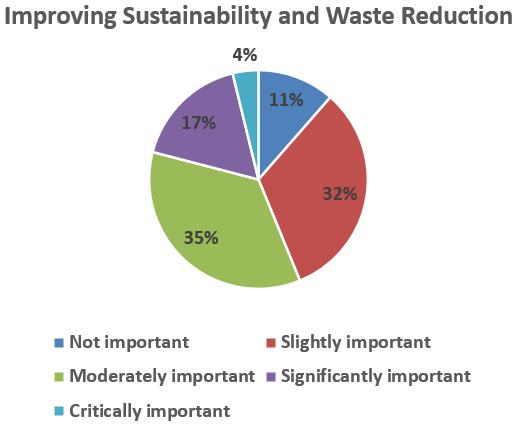 For some in-plants, demonstrating sustainability is important, especially if their parent organization values it. For others … it’s still a fringe term. Data from a new In-plant Impressions survey shows that 21% of in-plants view sustainability as either "critically" or "significantly" important, and 35% describe it as "moderately" important. While this is hardly a passionate embrace, it still shows that more than half of in-plants are paying attention to sustainability in some way.
At the Massachusetts Audubon Society, for example, sustainability is baked into the organization’s mission, which also makes it a priority for the in-plant.
“We are a conservation organization, dedicated to preserving nature and the environment, and we’re trying to lead by example,” says Bruce Boyd, supervisor of the Mass Audubon mailroom. He also points out a more practical reason for his shop’s green focus: “It made business sense to reduce waste and electricity usage. Our business is flat, not expanding, so this was an easy decision to make.”
Sheffield Hallam University (SHU), in Sheffield, England, however, doesn’t have sustainability as a core part of its mission, yet despite that, its in-plant has still embraced it.
“We believe it is the right thing to do, personally and from an organizational perspective,” notes Paul Bishop, head of Print Services. “If everyone does their bit, we may be able to hit the targets the world needs to hit. Also, just looking from a business perspective, more and more customers are choosing businesses that pay attention to sustainability, so it’s a win-win.”
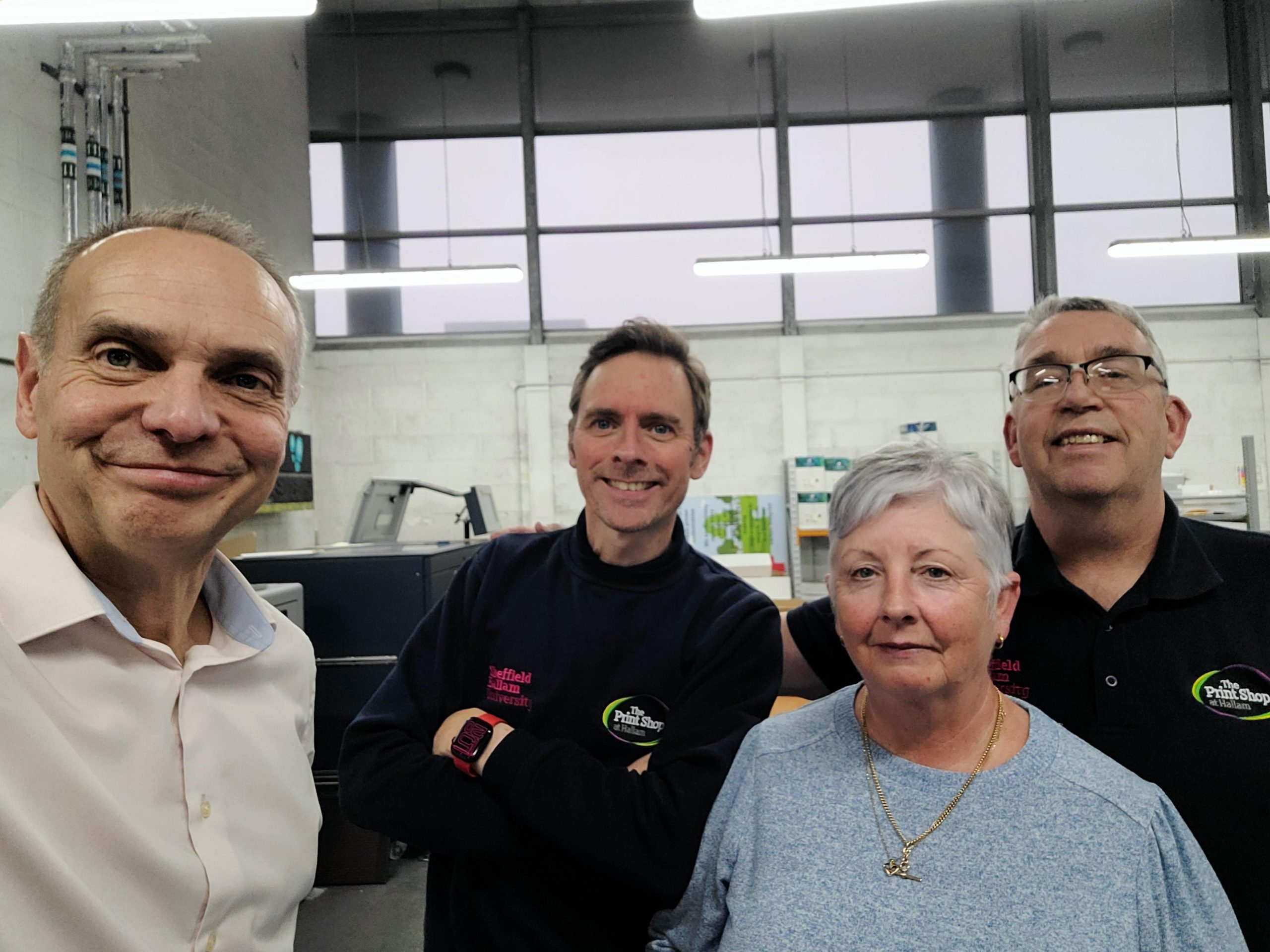
Sheffield Hallam University’s in-plant team has embraced sustainability. “We believe it is the right thing to do,” says Paul Bishop (left), head of Print Services. With him are (from left) Paul Clayton, Julie Butler, and Andrew Procter. | Credit: SHU
Alysia Robinette, publications specialist II at South Holland, Illinois-based South Suburban College (SSC), notes that her in-plant’s decision to be more sustainable combined those two reasons. The campus has a strong emphasis on sustainability and recycling, so it made sense for the in-plant to follow that lead.
“As much as possible, it is a priority,” says Robinette. “We are a community college, and we have a county-sponsored … recycling center on campus that does hard-to-recycle materials. We recycle things like Styrofoam and electronics, and we’ve also started hard drive shredding and document shredding. And we broke ground last year on a household hazardous waste facility. So, it’s an organization-wide commitment, and we have been part of it. But in some ways, some of these things are very easy now because things that we would have normally have trouble disposing of safely, we can literally just call up our physical plant and roll it across the campus.”
Walk the Sustainability Walk

“We are a conservation organization, dedicated to preserving nature and the environment, and we’re trying to lead by example,” says Bruce Boyd of the Massachusetts Audubon Society.
| Credit: Mass Audubon
There is, however, a difference between making sustainability a part of the in-plant’s mission, and actually implementing policies. So how are these three operations approaching it?
For Robinette, sustainability revolves around recycling as much as possible — not surprising given the facilities on campus. And that goes for the types of paper the in-plant is using as well.
“To the best of our ability, we’re pretty much recycling as much waste as we possibly can, so any papers, misprints ... packaging — in general, anything like that is now being recycled directly. We’ve made a pretty big commitment on that. And we’ve always used FSC-certified paper unless it’s absolutely required that we use something special for a job; 99% of what goes through has always been FSC certified.”
Recycling and using recycled paper is also a cornerstone of the strategy in use at Mass Audubon, along with choosing the right equipment to run it.
“We switched to 100% recycled paper where possible, and we minimize, reuse, and recycle our wastepaper,” Boyd explains. “We add more recycled types of paper as it becomes available. We reduced the number of printers we had from three to one, so we use less electricity, even at idle. The building we are in has solar panels that produce the equivalent of all the power used in the building over the year.” The in-plant also switched to toner devices, so there are no inks or VOCs to worry about mitigating.
At SHU, sustainability is seen in a few different ways. First, notes Bishop, the operation uses both FSC-certified paper, as well as being “part of the Woodland Trust and Forest Carbons schemes in the U.K., that capture and offset the carbon from the production and transportation of the paper, as well as plant trees, to create native U.K. woodland.”
In addition, he says, the in-plant recycles all of its waste consumables, and “we reuse all the boxes that consumables and paper come in as packaging for finished goods, thus reducing the amount of new boxes we need to buy.” Finally, he says, “The university has electric vehicles, which are used to collect and deliver goods around campus.”
And while SHU doesn’t turn its equipment off when not in use, the in-plant makes use of the automatic power-saving mode to conserve power when equipment is idle.
Talking the Sustainability Talk
Because customers pay attention to sustainability, promoting the in-plant’s green efforts can help drive business. SHU, for example, touts its sustainability efforts in staff digital newsletters and open house events.
“We also promote to our customers that they can have a Woodland Trust carbon capture logo added to their artwork,” Bishop says.
Robinette has plans to market her in-plant’s sustainability efforts along with the fact that customers can conserve resources by using the in-plant.
For Boyd’s in-plant, sustainability is more of a given.
“We are expected to do everything we can in an environmentally friendly manner,” he says. Which just goes to show how much an in-plant’s operations can be impacted by the
overall mission.
That said, it is clear that even in-plants in organizations not built around sustainability are making the environment more of a priority as the years go by. Using recycled and certified paper, taking advantage of power-saving modes, and recycling are all ways in-plants can easily improve sustainability efforts without needing to break the bank or burden staff.
And it is worth the effort, they say. Bishop sums it up best:
“I agree with [those who say] that print does have an effect on the environment, but then I explain so does everything else in daily life, such as how they got into work,” he says. “I then tell them about how sustainable print is, in terms of trees being grown as a crop, recycle rates, and how it’s possible to order only what you need when you need it, rather than stockpiling. I tell them about the benefits of print and how successful a campaign with digital media can be.”
“Sometimes,” agrees Boyd, “a printed piece of paper is the most useful document, viewable without machinery that uses electricity.”
Not every in-plant needs to make sustainability a core element of its business, but every in-plant can find small ways to be more environmentally conscious.
- Categories:
- Business Management - Sustainability
Toni McQuilken is the senior editor for the printing and packaging group.


