


Proving Your Value: Lessons From the In-plant Front Line

By the time I walked into my first meeting with my senior director at Vanderbilt University Printing Services, I had more than 20 years of experience in the commercial and retail printing industry under my belt — and plenty of confidence to match. I knew business. I knew profit. I knew how to win.
And yet, by the end of that meeting, I felt like a deer in the headlights, because the one thing I did not have was knowledge of the in-plant world.
I left questioning everything. Had I made a mistake leaving a role I had held for two decades? A job I was really good at? For years, my success had been measured by profit. Now, in the in-plant environment, I was being told something entirely different: Get as close to break-even as possible.
How hard could that be?
As it turns out, it is incredibly hard.
When you’ve spent more than 20 years focused on making money, learning how not to can be one of the most difficult professional shifts you’ll ever face. I wondered what I had been thinking — leaving comfort, familiarity, and confidence to step into an industry I barely understood.
The next morning, I shook off my nerves, leaned on my pride, and pushed forward. I’m glad I did. Because joining Vanderbilt University Printing Services was, without question, the best professional decision I’ve ever made.
Discovering a Different Kind of Industry
What I couldn’t have imagined then was just how different the in-plant world would be. I came from a highly competitive business — competitive even within the same company. Suddenly, I found myself surrounded by thousands of people across the university and in-plant professionals from around the country who genuinely wanted me to succeed.
I didn’t know a professional culture like this existed.
As my experience grew, so did my confidence. I stepped into a shop that was closed — or nearly there — and helped relaunch it. We grew from a team of three to a team of 10, with more growth on the horizon.
That brings me to the question I’m often asked: How did you prove your value?
Start With Yourself
The first evaluation wasn’t of the shop, it was of me. What was my attitude?
As a director, my mindset sets the tone. If I’m negative, the team feels it immediately. If I’m positive, they feed off that too. You’d be amazed at how closely a team mirrors its leader. I couldn’t expect anyone else to change if I wasn’t willing to lead by example.
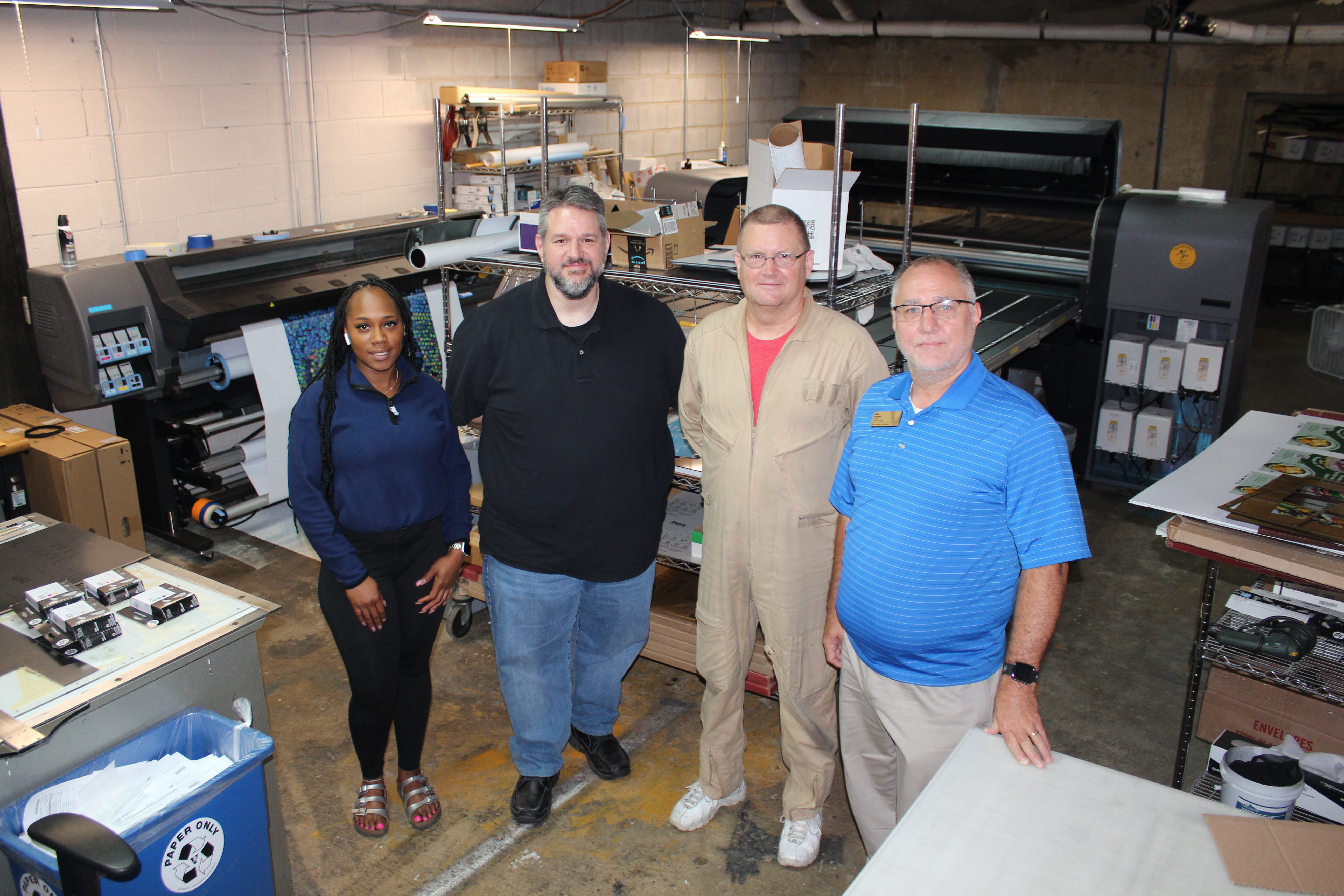
From left: Kendra Barker, Lance Piper, Sam Daugherty, and Mike Puckett stand in the in-plant’s wide-format area, which features flatbed and roll-fed printers, a Colex contour cutter, and an engraver.
Then I looked at my team — not as headcount or roles, but as people.
I sat down with each team member individually for real conversations. Not “what do you do here?” conversations, but who are you conversations. Who are you outside of work? What do you like? What don’t you like? Favorite snacks? Favorite foods?
Only after that did I ask the most important question: “If you could change one thing here, what would it be?”
Then I listened.
Once people open up, they have incredible ideas. You won’t be able to implement everything, but when they see their ideas turning into real change, everything shifts. They know you’re listening; they know you care.
And yes, I remembered the snacks.
For birthdays and work anniversaries, I bring each team member their favorite snack. When another in-plant manager once told me their organization wouldn’t pay for that, my response was simple:
“So what?”
If it costs me five dollars out of my own pocket, it’s still cheaper than losing a skilled employee who doesn’t feel appreciated. That $5 investment pays off in loyalty, morale, and retention.
Before you prove your value to anyone else, you must prove it to yourself and your team.
Relationships Before Transactions
Once my team was on board, I took the same approach with our customers, though in an in-plant environment, they’re really colleagues.

Standing with the Xerox Iridesse in the Vanderbilt University in-plant’s production facility are (from left) Keith Stringfield, Debbie Kennedy, and Mike Puckett. | Credit: Vanderbilt University
In my second week, I sent an introductory email to every director and administrative assistant I could find, asking for 10 minutes to put a name with a face.
Every meeting started the same way: “Tell me who you are outside the university.”
We talked about families, hobbies, and vacations. Then I shared my own story. Only after that did we talk about business.
I wasn’t trying to be a vendor. I was building relationships.
If someone had a negative experience with printing services in the past, I saw that as an opportunity. That first interaction with me would be different, guaranteed.
Relationships build trust. Trust builds business. When customers place their first order, I personally deliver it. I want to see their reaction immediately. Not every job is a home run, but if something isn’t right, I make it right. No excuses.
I don’t care if the error came from missing information or an approved proof. When customers see the effort I put into fixing it, they come back — and they tell others. Repeat business and word of mouth are the fastest ways to grow.
Say Yes — And Figure It Out
Another core value: I always say yes. Even if it’s outside my wheelhouse, I find a vendor or another in-plant that can handle it. To the customer, it’s seamless. They called me, and I delivered.
I want the challenging requests. When you pull those off, you earn trust — and loyalty.
Showing Value to Leadership
Once your team and customers believe in you, proving value to leadership becomes the easy part. Show your results. Often. Create a dashboard with metrics that matter to decision-makers: job volume, revenue, savings, customer satisfaction.
Mine is simple: revenue, in-house jobs, and customer survey results. Every customer receives a survey with their invoice. I share scores weekly with my senior director and customer comments monthly with my team. There’s nothing more motivating than hearing your name mentioned for doing great work. If numbers dip, don’t hide it. Explain why, and explain your plan.
Trust doesn’t stop at the shop door. It goes uphill too.
Growth Follows Value
Once you prove your value, doors start to open. In the last three years, we’ve added laser engraving, DTF printing, and promotional products. Each success has built momentum for the next opportunity.
I’ve made a big difference in three years—and I’m just getting started. Where will I be in three more? Five? 10? I can tell you this: forward.
This is how I define value. The question is: how do you define yours?
- Categories:
- Business Management - In-plant Justification
Mike Puckett is a results-driven leader with extensive experience in multi-unit operations, business development, and team leadership. Raised in a family-owned grocery business, he developed a strong work ethic early, shaping his commitment to operational excellence and customer service.
Mike has spent most of his life in Nashville, with additional professional experience in Memphis and New York. He earned his degree in Aerospace with a minor in Psychology from Middle Tennessee State University in 1991, becoming the first in his family to graduate from college. While initially pursuing a career as a pilot, he discovered his passion for leadership through retail management, which set the course for his professional journey. His career spans leadership roles with Walmart and FedEx Office, where he received numerous honors including Store of the Year and President’s Club recognition.
In 2022, Mike joined to Vanderbilt University to rebuild its Printing Services operation. Under his leadership, the team has grown significantly, expanding both in size and capabilities, with the addition of new services such as laser engraving and promotional products.


